For even the close partners of her thoughts
Who could have walked the nearest to her ray,
Worshipped the power and light they felt in her
But could not match the measure of her soul.
She had come into the mortal body’s room
To play at ball with Time and Circumstance.
A joy in the world her master movement here,
The passion of the game lighted her eyes:
 A marriage with eternity divinised Time.
There Life pursued unwearied of her sport
Joy in her heart and laughter on her lips,
The bright adventure of God’s game of Chance.
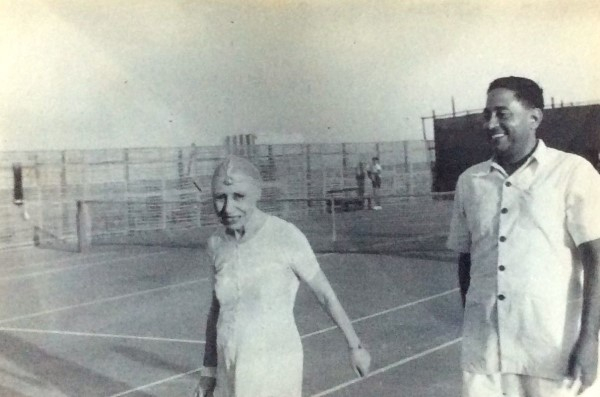
Her look, her smile awoke celestial sense
Even in earth-stuff, and their intense delight
Poured a supernal beauty on men’s lives.
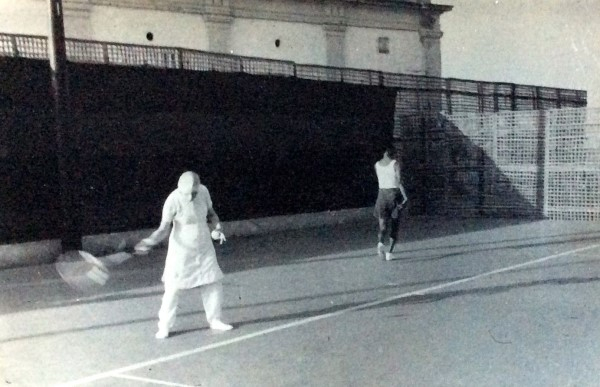
The omniscient Goddess leaned across the breadths
That wrap the fated journeyings of the stars
And saw the spaces ready for her feet.
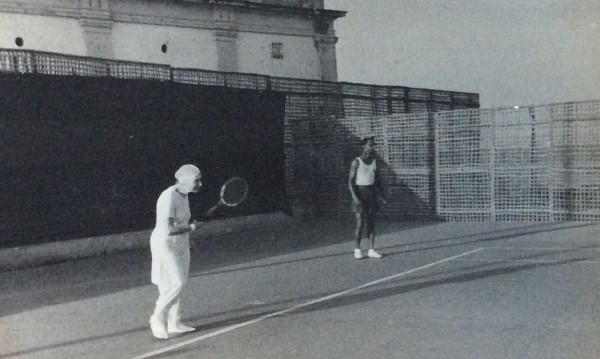
The little plot of our mortality
Touched by this tenant from the heights became
A playground of the living infinite.
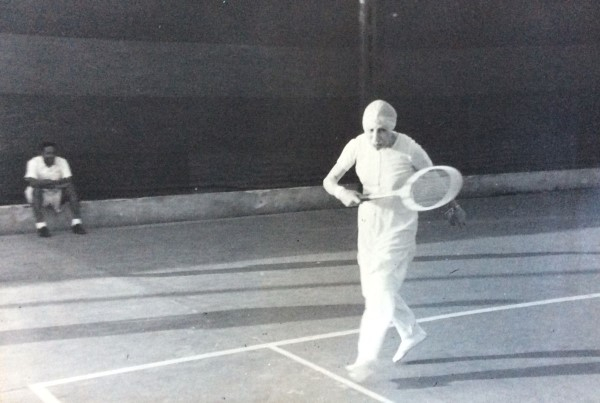
A cry and leap and hurry were around,
The stealthy footfalls of her chasing things,
Invaded by beauty’s universal revel
Her being’s fibre reached out vibrating
And claimed deep union with its outer selves,
The fluctuating chance turns of her mood,
Works out her meanings she seems not to know
And serves her secret purpose in long Time.
Her measure they could not reach but bore her touch,
Answering with the flower’s answer to the sun
They gave themselves to her and asked no more.
Beautiful !
I happen to see this yesterday and wanted to comment, forgot and promptly was reminded via this email. What a beautiful way to put Savitri’s description of The Mother to these photo’s! Inspiring, an offer to her GRace. Thank you.
Ma
Recently played Tennis for first time.It took away all my neck and shoulder pain.
Mother and Dada’s together makes me feel happy.
~
Source:
THE DIVINE MOTHER
“THIS IS SHE”
https://www.searchforlight.org/Nirod/THE%20DIVINE%20MOTHER%20.html
We must remember, however, that activity by itself, of whatever kind, is of secondary importance, but “taken as pan of the sadhana offered to the Divine or done with the consciousness or faith that it is done by the Divine Power” – that is the important point.
Now we come to a different field of activity altogether, one whose place in Yoga will be strongly challenged, especially when the Mother herself used it as a means of sadhana: her playing tennis. I won’t discuss the issue, for the quotation cited above gives the answer. Before she started playing tennis the Mother joined our young group in playing table-tennis. When a young boy asked her if he could install a table in his house for the game, the Mother replied, “Why not at Nanteuil?¹ then I can come and play too.” He was much surprised and delighted at the divine proposal! She must have found it a good light exercise as well as an admirable means of contact with the young set which was gradually increasing; it was perhaps also her yogic means of action upon them. After a year or so the Mother decided to have a tennis court. She might have felt that she needed some more brisk exercise in the open air. She often talked of her project to Sri Aurobindo. One day we heard that the entire wasteland along the north-eastern seaside was taken on a long lease from the Government and a part of it would be made into tennis courts and the rest into a playground. One cannot imagine now what this place was like before. It was one of the filthiest spots of Pondicherry, full of thistles
¹. A building opposite the Ashram Playground.
and wild undergrowth, an open place for committing nuisance as well as a pasture for pigs! The stink and the loathsome sight made the place a Stygian sore and a black spot on the colonial Government. The Mother changed this savage wasteland into a heavenly playground, almost a supramental transformation of Matter. The sea-front was clothed in a vision of beauty and delight. If for nothing else, for this transformation at least, Pondicherry should be eternally grateful to the Mother. But who remembers the past? Gratitude is a rare human virtue. I was particularly very happy, first, because I was fond of tennis; secondly, I fancied that Yoga would be now made easy. Who could ever think of tennis in Yoga! But woe to me, how it completely upset my balance!
All this, however, is by the way. My point was to demonstrate the Mother’s method of working. As soon as the plot was acquired, she went about the work in her usual one-pointed manner. And what a job it was! To build a long rampart against the surges of the sea was itself a gigantic enterprise for a private institution like our Ashram without any income of its own. But I shall confine myself to the construction of the tennis courts only. She did not count the expense; men and money were freely employed, for the courts had to be made ready within a minimum period of time. We have observed that when the Mother feels the need for a work to be done, she goes ahead, confident that the required resources will come. In the present case, there was also the question of the right worker to see the project through. The Mother said to Sri Aurobindo, “I know there is one man who can do it.” It was Monoranjan Ganguli, a sadhak. I saw him at this work and was really amazed at his wonderful devotion to the Mother, his determination to fulfil the trust she had placed in him. He supervised the operation with unfailing love and duty and cool temper, making the tennis ground his home and passing many sleepless nights sitting on a stool. When I asked him why he should be in such a hurry, he replied, “Mother wants it so. I must finish it within the appointed time.” “Is it possible? Only a few days are left!” I voiced my doubt. “Oh, I must!” and he did. A singular feat indeed, and again the Mother’s right choice.
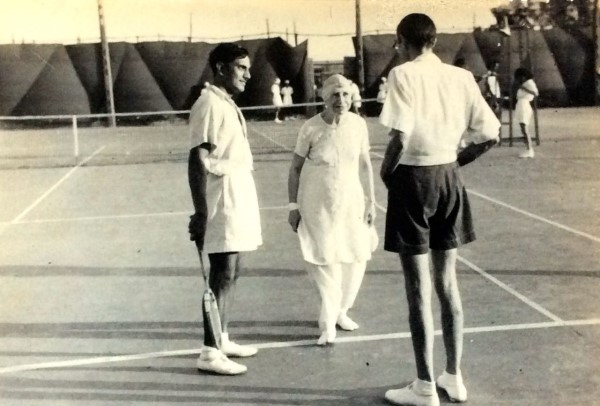
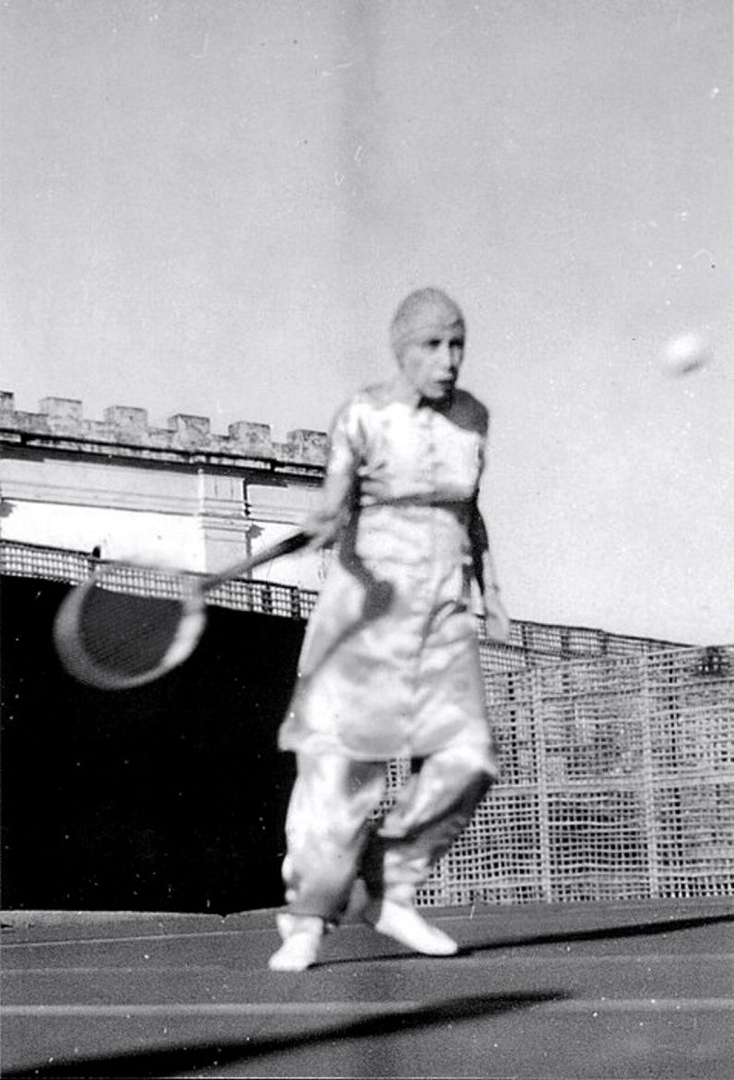
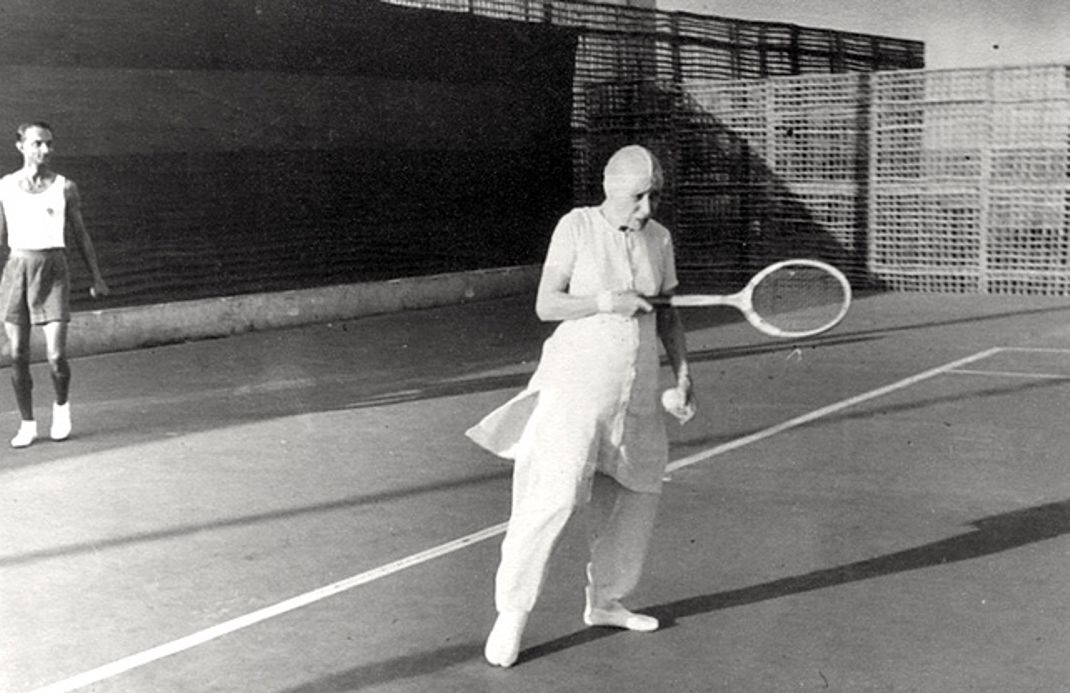
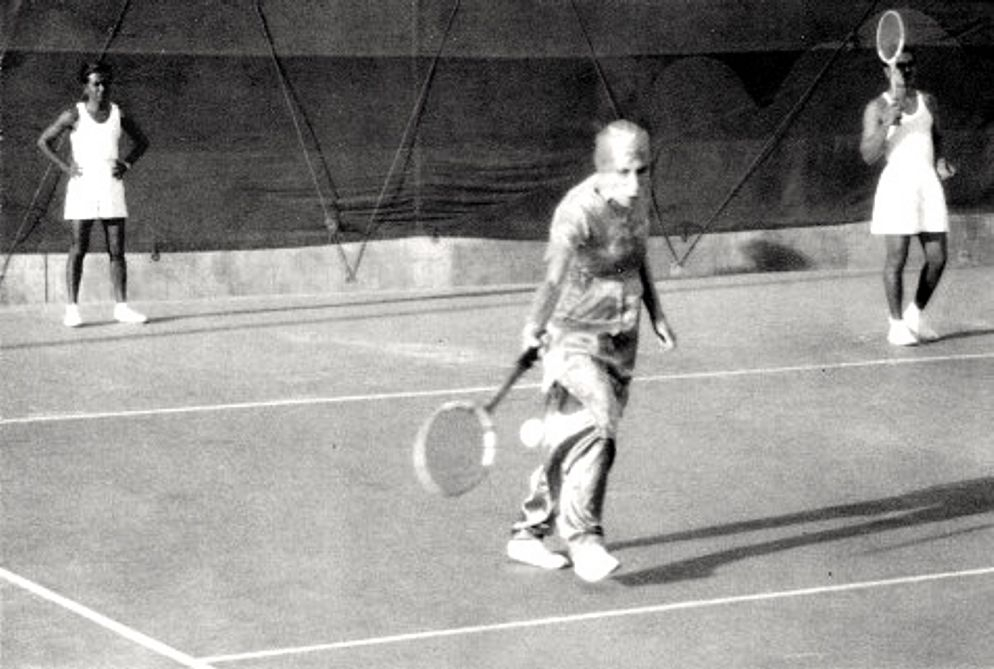
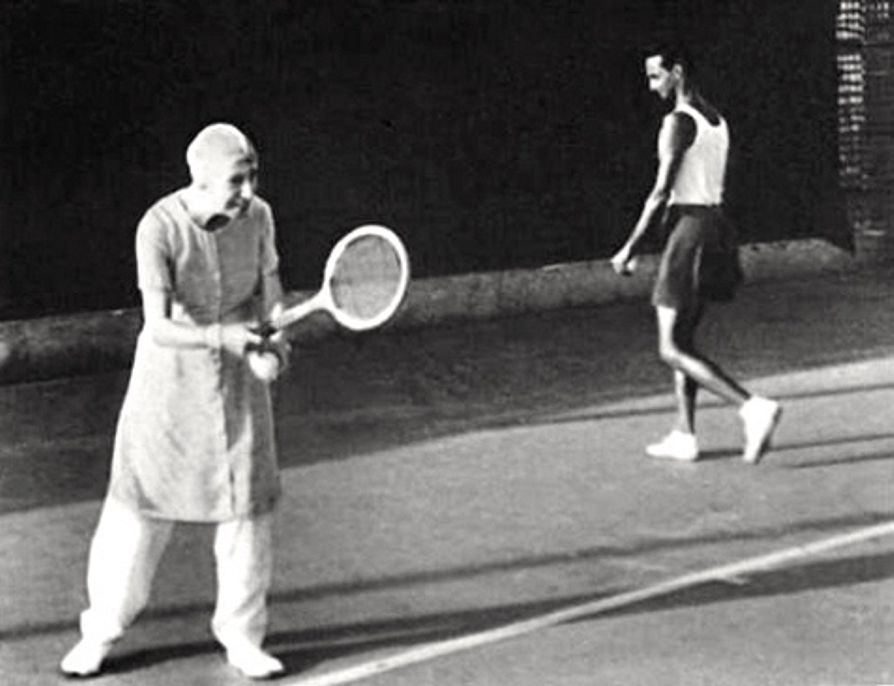
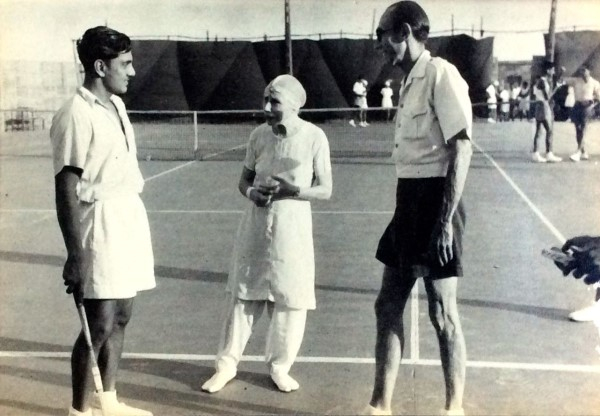
When the courts were ready, there followed a change in our programme. Henceforth Sri Aurobindo’s noon meal was served earlier so that the Mother could go out by 5.00 p.m. She would come to Sri Aurobindo’s room dressed in her specially designed tennis costume. She played for about an hour with a number of young people in turn, even took part in tournaments. From there she came to the Playground and, after another bout of crowded activities, returned to the Ashram at about 8.00 or 9.00 p.m.
She played very well for her age, and her claim that she had become a champion in her youth was amply borne out by her steady, sharp forehand strokes which were above all a marvel of precision. Naturally she could not run a great deal, but her agility was remarkable. In her vision tennis is the best game spiritually and physically. She used it not only for her physical fitness, but as in everything else, as a medium for her spiritual action on the players. It was this inner movement that interested her as much as the outer one. For, playing with the Divine meant an aspiration, opening, right attitude, reception of her force through the game, as through other means like physical and mental activity. Here, of course, the manner is more direct and more joyful. In other words, it was used more as a means of sadhana. When someone had some inner difficulties, she would invite him for a game with her and the effect was almost miraculous. On the other hand, she would suddenly stop calling for many days or altogether, a person with whom she had played almost regularly. These are nothing but vagaries, one would be inclined to observe. But they were not; the person involved often knew very well the inner reason. Someone asked the Mother in another context which involved certain hardships, if she put people to test. She replied, “Never! people have already enough difficulties, why should we add more? But there are inner tests.” Too subtle, swift and mysterious are her ways to be grasped by our human mind; so I will refrain from going into the matter. On our birthdays she used to invite us specially to play a set with her. The joy that she imparted to us by this means can be compared to the joy that we had in our talks with Sri Aurobindo, different in kind, of course.
I shall relate an interesting account of the Mother’s diplomacy in this field of tennis. There used to be friendly tournaments under the Mother’s supervision. Once my partner and I had reached the finals and were to face a younger pair who were known to be the Mother’s favourites. Gods, goddesses especially, have their chosen ones, if the Puranas are to be believed, and they always win. Of course we are to assume that there are larger purposes which we cannot guess, behind the seeming partialities. The Mother broached the topic of the game to Sri Aurobindo and asked me naively how we were going to fare, what would be our tactics, etc., etc. I would not be caught so easily. Then she employed a familiar strategy, “You know they are a very good pair; you have no chance against them.” Thus she went on battering me. Sri Aurobindo listened to it with an amused smile. When, finishing my duty, I was going for the game, I asked Champaklal to plead to Sri Aurobindo on our behalf. The play started, there was quite a crowd. The Mother was watching with keen interest. The upshot was that we lost sadly and badly. Curiously enough, we missed even simple shots. On my return in the evening, I told Champaklal of our ignoble defeat. Later on, Sri Aurobindo himself enquired and learning from Champaklal about the result, he enjoyed the joke and laughed aloud. I did not know what gave him so much amusement. Failure of his own force? Did he give force at all? Success of the Mother’s favourites? The Mother, however, in her turn, gave a long report of the game. She said, “Oh, they became so nervous! I tried all the while to make them steady, but of no use. They missed even simple shots!” I made no outer comment but was inwardly muttering, “What chance could we have if you had already decided our doom as Krishna that of the Kauravas?” Doom is the word, in a deeper sense too, for as I have hinted, I became inordinately attached to tennis and neglected even my duty. It was like an old love that had revived with all its insensate passion and I had to receive persistent psychological beating from the Mother before I could get rid of this folly. Sri Aurobindo once wrote to me, “Never! [forsake you] But beat – a lot.” The beating came mostly from the Mother.
Let me illustrate. I shall restrict myself to the field of tennis. After Sri Aurobindo’s passing I thought of giving up tennis for good. The Mother said, “Why? You will play with me.” Every day I went to the tennis ground and she called me for a game. This led to the revival of my old passion which had been arrested due to Sri Aurobindo’s illness. I was not satisfied with merely playing a few games with the Mother. Besides, as I had no regular duty to bind me, I began to indulge in it with abandon. Suddenly the Mother stopped playing with me and for many days at a stretch, I was mystified. Every day I waited, hoping to be called; she would call many others, but ignore me. The contrast was too flagrant. I felt rather humiliated. Curiously enough, whenever I had stopped playing at other times, she gave me a chance. The apparent connection between the two made me suspect that she wanted me to give up playing with others except with herself. As to how she knew which day I had played or abstained from playing, that was no riddle to anyone who knew her well. But I could not give up the game so easily. Also, I thought, “Why should I give it up? What’s wrong with it? It is a good pleasant exercise!” Moreover, I wanted to be quite sure of my suspicion and continued playing till I found that there was a clear connection. She called me only when I had not played with others. This “cutting” became so painful to me and palpable to others that I thought of not going to the courts while she played, but some force dragged me there, not exactly in expectation of a game but so as not to give in to my sense of pride and prestige. I observed that she took note of my presence and I was one of the referees during her play. I also thought, “If she had some accident while playing (an accident did happen later) and I was not there? What account should I give to Sri Aurobindo in my inner communion with him? I must swallow my amour-propre.”
During the sports season, she went to the sports ground after her tennis. Instead of following her, I stayed to enjoy a game. But when I had followed her, she took note of my presence by a fugitive glance for no apparent reason. This happened so often that even a dull person would not fail to perceive the meaning. Thus the battle raged on: sense of humiliation, struggle to keep the right attitude, doggedness to stick to my self-will and a host of other psychological complexes. At last the relentless silent pressure won and I gave up tennis. This is our human nature. When it is evident that the Divine wants to do something for my good, I refuse either out of attachment, self-justification or sheer disobedience. Change of nature is such an uphill job. It is not for nothing that the Guru said in 1936, that changing the nature of 150 inmates of the Ashram was a job! The interesting point was that the Mother never voiced her wish in words. Her way is usually subtle. She has said that unless she could control a movement by a silent gesture or look, she had not gained a complete mastery. Neither did I ask her what should have been my attitude towards the play. If I did, she would probably have answered. When she said, “You will play with me”, I could not grasp the inner meaning that I should play with her alone. This is one of the methods she employs to open us to higher perceptions than those of reason.