The Importance of Small Beginnings — Sri Aurobindo

“I will try again” is not sufficient; what is needed is to try always—steadily, with a heart free from despondency, as the Gita says, anirviṇṇacetasā. You speak of five and a half years as if it were a tremendous time for such an object, but a Yogi who is able in that time to change radically his nature and get the concrete decisive experience of the Divine would have to be considered as one of the rare gallopers of the spiritual Way. Nobody has ever said that the spiritual change was an easy thing; all spiritual seekers will say that it is difficult but supremely worth doing. If one’s desire for the Divine has become the master desire, then surely one can give one’s whole life to it without repining and not grudge the time, difficulty or labour.

Again you speak of your experiences as vague and dreamlike. In the first place the scorn of small experiences in the inner life is no part of wisdom, reason or common sense. It is in the beginning of the sadhana and for a long time the small experiences that come on each other and, if given their full value, prepare the field, build up a preparatory consciousness and one day break open the walls to big experiences. But if you despise them with the ambitious idea that you must have either the big experiences or nothing, it is not surprising that they come once in a blue moon and cannot do their work. Moreover, all your experiences were not small. There were some like the stilling descent of a Power in the body—what you used to call numbness—which anyone with spiritual knowledge would have recognised as a first strong step towards the opening of the consciousness to the higher Peace and Light. But it was not in the line of your expectations and you gave it no special value. As for vague and dreamlike, you feel it so because you are looking at them and at everything that happens in you from the standpoint of the outward physical mind and intellect which can take only physical things as real and important and vivid and to it inward phenomena are something unreal, vague and truthless. The spiritual experience does not even despise dreams and visions; it is known to it that many of these things are not dreams at all but experiences on an inner plane and if the experiences of the inner planes which lead to the opening of the inner self into the outer so as to influence and change it are not accepted, the experiences of the subtle consciousness and the trance consciousness, how is the waking consciousness to expand out of the narrow prison of the body and the body-mind and the senses? For, to the physical mind untouched by the inner awakened consciousness, even the experience of the cosmic consciousness or the Eternal Self might very well seem merely subjective and unconvincing. It would think, “Curious, no doubt, rather interesting, but very subjective, don’t you think? Hallucinations, yes?” The first business of the spiritual seeker is to get away from the outward mind’s outlook and to look at inward phenomena with an inward mind to which they soon become powerful and stimulating realities. If one does that, then one begins to see that there is here a wide field of truth and knowledge, in which one can move from discovery to discovery to reach the supreme discovery of all. But the outer physical mind, if it has any ideas about the Divine and spirituality at all, has only hasty a priori ideas miles away from the solid ground of inner truth and experience.

I have not left myself time to deal with other matters at any length. You speak of the Divine’s stern demands and hard conditions—but what severe demands and iron conditions you are laying on the Divine! You practically say to Him, “I will doubt and deny you at every step, but you must fill me with your unmistakable Presence; I will be full of gloom and despair whenever I think of you or the Yoga, but you must flood my gloom with your rapturous irresistible Ananda; I will meet you only with my outer physical mind and consciousness, but you must give me in that the Power that will transform rapidly my whole nature.” Well, I don’t say that the Divine won’t or can’t do it, but if such a miracle is to be worked, you must give Him some time and just a millionth part of a chance.

The Place of Experience in the Practise of Yoga, Letters on Yoga-III, CWSA, Sri Aurobindo.
Posted in Experiences, Sadhana, Soul, Sri Aurobindo | Leave a comment

Desire Is The Badge of Subjection — Sri Aurobindo

The cause of ego is that while by Its double power of Vidya and Avidya the Spirit dwells at once in the consciousness of multiplicity and relativity and in the consciousness of unity and identity and is therefore not bound by the Ignorance, yet It can, in mind, identify Itself with the object in the movement, absorbingly, to the apparent exclusion of the Knowledge which remains behind, veiled at the back of the mentality. The movement of Mind in Nature is thus able to conceive of the object as the reality and the Inhabitant as limited and determined by the appearances of the object. It conceives of the object, not as the universe in one of its frontal appearances, but as itself a separate existence standing out from the Cosmos and different in being from all the rest of it. It conceives similarly of the Inhabitant. This is the illusion of ignorance which falsifies all realities. The illusion is called ahaṁkāra, the separative ego-sense which makes each being conceive of itself as an independent personality.

The result of the separation is the inability to enter into harmony and oneness with the universe and a consequent inability to possess and enjoy it. But the desire to possess and enjoy is the master impulse of the Ego which knows itself obscurely to be the Lord, although owing to the limitations of its relativity, it is unable to realise its true existence. The result is discord with others and oneself, mental and physical suffering, the sense of weakness and inability, the sense of obscuration, the straining of energy in passion and in desire towards self-fulfilment, the recoil of energy exhausted or disappointed towards death and disintegration.

Desire is the badge of subjection with its attendant discord and suffering. That which is free, one and lord, does not desire, but inalienably contains, possesses and enjoys.

Analysis, Isha Upanishad, CWSA, Sri Aurobindo.

Posted in Life, Sri Aurobindo, Thoughts to ponder | Leave a comment

Praying to The Mother — Sri Aurobindo

You say, “When one is a sadhak the prayer should be for the inner things belonging to the sadhana and for outer things only so far as they are necessary for that and for the Divine work.” This latter portion about prayer for outer things is not clear to me. Can you kindly explain?

All depends on whether the outer things are sought for one’s own convenience, pleasure, profit etc., or as part of the spiritual life, necessary for the success of the work, the development and fitness of the instruments etc. It is a question mainly of inner attitude. If for instance you pray for money for buying nice food to please the palate, that is not a proper prayer for a sadhak; if you pray for money to give to the Mother and help her work, then it is legitimate.

I quote several types of prayers which I offer and shall be grateful to know which of them are outer or inner, right or wrong, helpful or hindrance, or what amendment to them can make them pure:

1) In the night-time when I sit to read and an untimely attack of sleep comes, I pray to the Mother to be freed from the attack.

If your reading is part of the sadhana, that is all right.

2) When I go to sleep, I pray to the Mother for her Force to take over my sadhana during the sleep, to make my sleep conscious and luminous, to protect me during the sleep, to keep me conscious of the Mother.

3) When I wake up any time in the sleep, I pray to the Mother to be with me and protect me.

These two are part of the sadhana.

4) While going out for a walk and during it, I pray to the Mother to give me force to take more exercise and to gain more strength and health and I thank the Mother for the help.

If strength and health are requested as being necessary for the sadhana and the development of the perfection of the instrument it is all right.

5) When I see any dog on the way while walking, I at once pray to the Mother to protect me from its attack and remove my fear.

A call for protection is always permissible. The removal of fear is part of the sadhana.

6) When I go for food, I pray for the Mother’s Force to help me to offer every morsel to the Mother, to get everything easily digested, to make a growth of complete equality and detachment in my consciousness enabling me to take any food with equal Rasa of universal Ananda without any insistence or seeking or greed or desire.

This is again part of the sadhana.

7) When I go for work, I pray for the Mother’s Force to take over my work, help me and make me do it well and carefully with love, devotion and pleasure, with the remembrance of the Mother and the feeling of being supported and helped by her without ego or desire.

This also.

8) During the work also when there is a pause, I pray for force, help and constant remembrance.

This also.

9) When any bad or impure thought, seeing or sensation comes into me, I pray for its removal and purity.

This also.

10) When I am reading, I try to pray when possible to understand all quickly, to grasp and absorb completely.

If it is as sadhana or for the development of the instrument, it is all right.

11) When I commit any mistake in the work, I pray to be more conscious, alert and unerring.

This also is part of the sadhana.

12) When I go to the post office to register a parcel of Prasad to my friend, I pray to have the parcel accepted immediately and avoid any delay.

That can be done, if avoidance of waste of time is considered as part of the right regulation of the life of sadhana.

13) When I sit down for meditation, I pray for Mother’s Force to take over my meditation and make it deep, steady, concentrated and free from all attacks of troubling thoughts, vital restlessness, etc.

This is part of the sadhana.

14) In depression, difficulty, wrong suggestions, doubt, inertia, on any occasion or happening I pray to the Mother to have courage, keep faith, face them and overcome them.

This also.

15) At all other times as far as I can, I pray to the Mother to fill me with her peace, power, light etc., or offer any other kind of required prayer, and thank her for supporting, strengthening and sustaining me.

This also.

September 16th 1938, The Mother and Practise of Integral Yoga, CWSA.

Posted in Sadhana, Soul, The Mother | 2 Comments

Karma and Heredity — Sri Aurobindo

You must realise that all human beings are made partly of what is given them by their ancestors (not only father and mother but all the ancestors), partly of what they bring with them. The part they get from the ancestors is called hereditary—it is part (not the whole) of the physical and lower vital consciousness, sometimes a little of the external mind also—it is a small portion of the external being, but although small, it is sometimes very persistent and active. The rest of the being, inner and a great part too of the external, is brought from past lives. This hereditary part has to be got rid of and replaced by the true individuality spreading itself to the whole external nature.

Questions on Spiritual and Occult Knowledge, Letters on Yoga I, CWSA, Sri Aurobindo.

Posted in Sadhana, Soul, Sri Aurobindo | Leave a comment

The Nature of Desire — Sri Aurobindo

When you clutch at anything and try to make it your own with an egoistic sense of possession, then however beautiful and wonderful it may be, it loses its value and becomes ordinary.

***

It is not a demand to ask for things that one finds helpful, but it becomes a demand if there enters into it a feeling of claim, resentment when it is not conceded or other vital reactions. Be on your guard against any invasion by these reactions; the vital can only be conquered and changed and the physical opened up on a basis of faith and surrender and the psychic response overpowering all others.

Sadhana on the Level of Vital, Letters on Yoga – IV, CWSA, Sri Aurobindo

Posted in Sadhana, Soul, Sri Aurobindo | Leave a comment

These Things Become Marvellous Gifts — Mother

When things happen which are not what we expect, what we hope for, what we want, which are contrary to our desires, in our ignorance we call them misfortunes and lament. But if we were to become a little wiser and observe the deeper consequences of these very same events, we would find that they are leading us rapidly towards the Divine, the Beloved; whereas easy and pleasant circumstances encourage us to dally on the path, to stop along the way to pluck the flowers of pleasure which present themselves to us and which we are too weak or not sincere enough to reject resolutely, so that our march forward is not delayed. One must already be very strong, very far along the way, to be able to face success and the little enjoyments it brings without giving way. Those who can do this, those who are strong, do not run after success; they do not seek it, and accept it with indifference. For they know and appreciate the value of the lashes given by unhappiness and misfortune. But ultimately the true attitude, the sign and proof that we are near the goal, is a perfect equality which enables us to accept success and failure, fortune and misfortune, happiness and sorrow with the same tranquil joy; for all these things become marvellous gifts that the Lord in his infinite solicitude showers upon us.

Aphorism 34, Thoughts and Aphorism, CWM, The Mother.

Posted in The Mother, Travelling the Path | 1 Comment

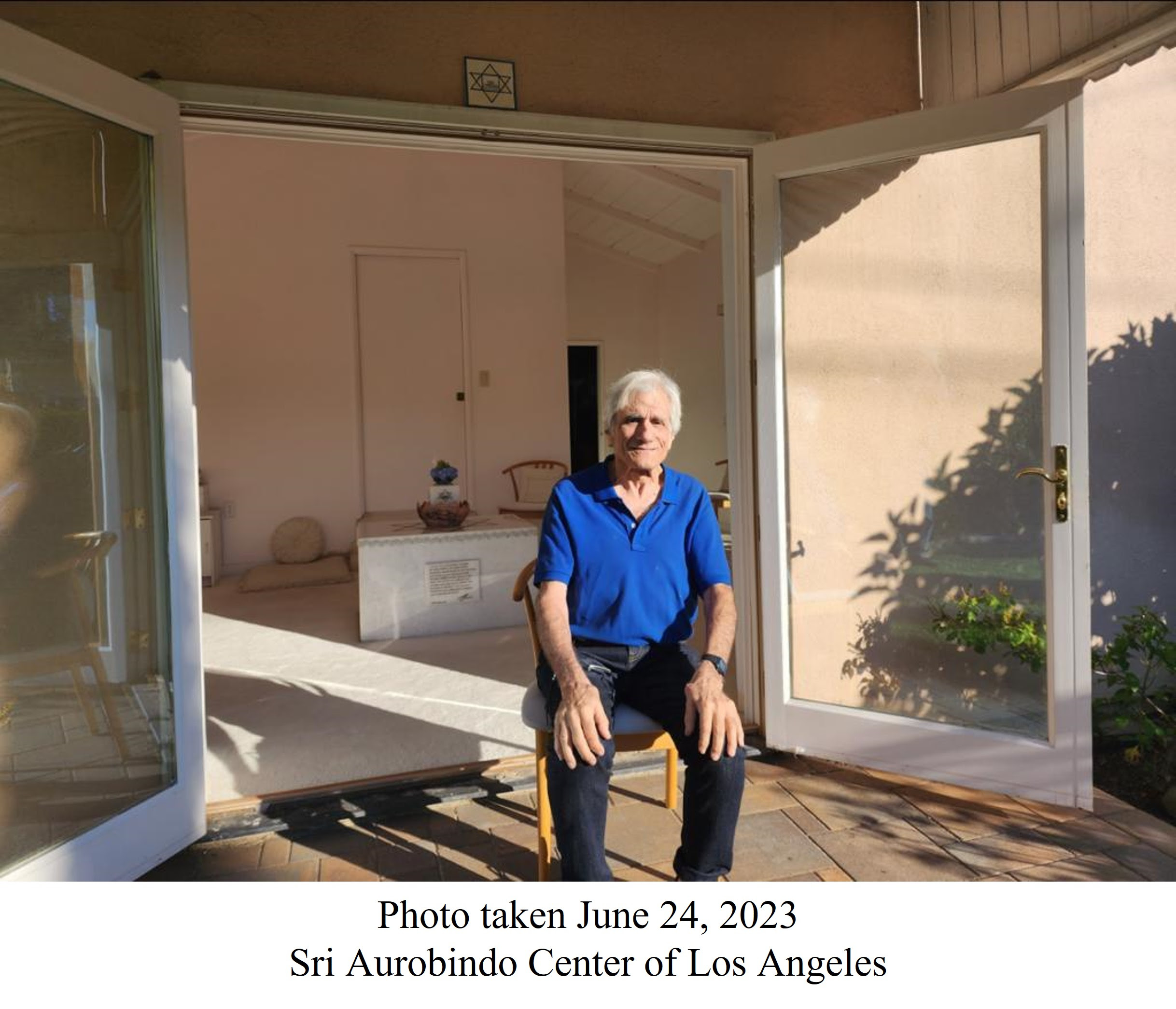
Dorian Schneidman’s passing away anniversary

Today, July 20, 2024, marks the first anniversary of Dorian Schneidman’s passing away. Although the irreversible passage of time carries with it all life and its movements into some mysterious unknown, and memories recede and fade in the “common light of earthly day”, Dorian’s knowledge, love and care for the Center’s garden is indelibly inscribed in it, unfaded, and smiles and reinvigorates all who visit by its varied splendor. His personality was no less diverse; its multifarious aspects manifested in his multifaceted work-offerings to the Center.

Beyond and above all these, his soul’s attraction to Sri Aurobindo, the driving force behind his unbroken service of more than four decades to the Center and a symbol of the Master’s Grace and love for him, continues to inspire us to a greater self-giving to the Master.

Posted in Soul | Leave a comment

Three Conditions for a Disciple — Sri Aurobindo

There are three conditions for a disciple for profiting fully from his relation to a spiritual guide.

1st: He must accept him entirely and him alone without submitting himself to any contrary or second influence.

2nd: He must accept the indications given by the Guru and follow them firmly and with full faith and perseverance to the best of his own spiritual capacity.

3rd: He must make himself open and receptive to the Guru for even more than what the Guru teaches to the mind of the disciple, it is what he spiritually is, the spiritual consciousness, the knowledge, the light, the power, the Divinity in him that helps the disciple to grow by his receiving that into himself and its being used within himself for the growth of his consciousness and nature into its own divine possibility.

The Path of the Integral Yoga, Letters on Yoga – II, CWSA, Sri Aurobindo.

Posted in Sadhana, Soul, Sri Aurobindo | 2 Comments

The Physical Mind and Peace and Silence — Sri Aurobindo

To get rid of the random thoughts of the surface physical mind is not easy. It is sometimes done by a sudden miracle, as in my own case, but that is rare. Some get it done by a slow process of concentration, but that may take a very long time. It is easier to have a quiet mind with things that come in passing on the surface, as people pass in the street, and one is free to attend to them or not—that is to say, there develops a sort of double mind, one inner silent and concentrated when it pleases to be so, a quiet witness when it chooses to see thoughts and things,—the other meant for surface dynamism.

***

There is always a difficulty in keeping the physical mind within or silent, because it has been its nature to occupy itself with outward things and it finds a difficulty in accustoming itself to a contrary movement. You must not be depressed by that, but persist in the aspiration and will till it is done. The Mother’s Force will be there to bring it about as soon as possible.

Sadhana on the Level of Mind, Letters on Yoga – IV, CWSA, Sri Aurobindo.

Posted in Sadhana, Soul, Sri Aurobindo | Leave a comment

The Mother And The Sadhana in The Ashram — Sri Aurobindo

The basis of life here(Ashram) is wholly spiritual. An inner discipline is given, but it is on broad lines allowing each individual the necessary freedom for his nature and temperament to grow and change spontaneously. Broadly, the sadhana consists of a progressive surrender of oneself—inward and based upon it the outward also—to the Guru, to the Divine; meditation, concentration, work, service—all these are means for a self-gathering in all one’s movements with the sole aim of delivering oneself into the hands of a Higher Power for being worked on and led towards the Goal. The Mother guides, helps each according to his nature and need, and, where necessary, herself intervenes with her Power enabling the sadhak to withstand the rigours and demands of the Path. She has placed herself—with all the Love, Peace, Knowledge and Consciousness that she is—at the disposal of every aspiring soul that looks for help.

Letters on the Mother, CWSA, Sri Aurobindo.

Posted in Sadhana, Soul, The Mother | 1 Comment