(1) A complete sincerity and surrender in the being. The divine life and the transformation of the lower human into the higher divine nature must be made the sole aim of all the life. No attachments, desires or habits of the mind, heart, vital being or body should be clung to which come in the way of this one aspiration and one object of the life. One must be ready to renounce all these completely as soon as the demand comes from above and from the divine Shakti.
(2) A fundamental calm, peace and purity in the mind, vital being and all the nature.The hours of meditation should be devoted to the formation of these two conditions in you, by aspiration and by self-observation and rejection of all that disturbs the nature or keeps it troubled, confused and impure. Aspiration if rightly done, quietly, earnestly and sincerely, brings the divine help from above to effect this object.
As to the hours devoted to work, needs, family, etc., hey can be made an aid only on the following conditions.
(1) To regard all these things as not belonging to yourself, your inner being, but as things external, work to be done so long as it remains on your shoulders to the best of your ability without desire or attachment of any kind.
(2) To do all work as a sacrifice without any egoistic motive.
(3) To establish and deepen the inner calm and quiet. If that is done, all these things will be felt more and more as external and the falling off of desire and attachment will become possible.
For getting rid of passion the same condition. If you separate yourself from these movements and establish calm and peace inside, the passions may still rise on the surface, but they will be felt to be external movements and you can deal with them or call down the divine aid to get rid of them. So long as the mind does not fall quiet, it is not possible to deal finally with the vital being from which these forces rise.
The Path of Integral Yoga, Letters on Yoga II, CWSA.
[“Our yoga is not a past-time, or part-time activity ….otherwise it may take 100K years]
Questions to the Mother: “Sweet Mother, how can we find the Divine who is hidden in us?”
Mother’s Answer:This we have explained many, many times. But the first thing is to want it, and know precisely that this comes first, before all other things, that this is the important thing. That is the first condition; all the rest may come later, this is the essential condition. You see, if once in a while, from time to time, when you have nothing to do and all goes well and you are unoccupied, suddenly you tell yourself, “Ah, I would like so much to find the Divine!”—well, this—it may take a hundred thousand years, in this way.But if it is the important thing, the only thing that matters, and if everything else comes afterwards, and you want nothing but this, then—this is the first condition. You must first establish this, later we may speak of what follows. First this, that all the rest does not count, that only this counts, that one is ready to give up everything to have this, that it is the only thing of importance in life. Then one puts oneself in the condition of being able to take a step forward.
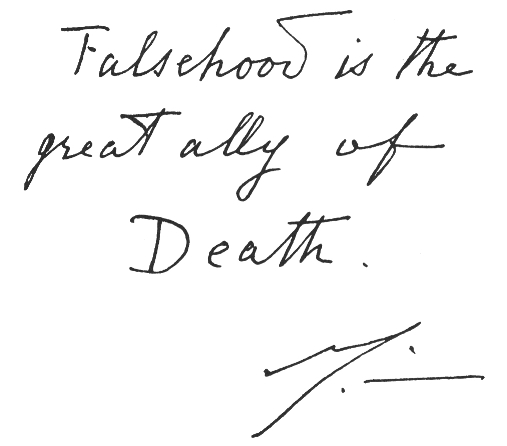
For those who are eager to get rid of falsehood here is the way. Do not try to please yourself, do not try either to please others. Try only to please the Lord.Because He alone is the Truth. Each and every one of us, human beings in our physical body, is a coat of falsehood put on the Lord and hiding Him.As He alone is true to Himself, it is on Him that we must concentrate and not on the coats of falsehood.
***
Let us offer our falsehood to the Divine so that He may change it to joyous Truth.
***
May the Truth be invincible, overwhelming, all-powerful, leaving no room for falsehood anywhere and for ever.
The Mother, Truth and Speech, Elements of Yoga, CWM.
For one who wants to practise sadhana, sadhana must come first—reading and mental development can only be subordinate things.
*
Reading can be only a momentary help to prepare the mind. But the real knowledge does not come by reading. Some preparation for the inner knowledge may be helpful—but the mind should not be too superficially active or seek to know only for curiosity’s sake.
*
If by passivity of the mind you mean laziness and inability to use it, then what Yoga makes that its basis? The mind has to be quieted and transformed, not made indolent and useless. Is there any old Yoga that makes it a rule not to allow those who practise it to study Sanskrit or philosophy? Did that prevent the Yogis from attaining mental quietude? Do you think that the Mother and myself never read anything and have to sit all day inactive in order to make our minds quiet? Are you not aware that the principle of this Yoga is to arrive at an inner silence in which all activities can take place without disturbing the inner silence?
*
I don’t think it would be advisable not to read at all. It is a relaxation of the tension of sadhana which can be at the same time useful to the mind. It is only when there is the spontaneous flow of sadhana all day without strain that reading is no longer needed.
It has been said that in order to progress in Yoga one must offer up everything to the Divine, even every little thing that one has or does in life. What is precisely the meaning of that?
Mother: Yoga means union with the Divine, and the union is effected through offering—it is founded on the offering of yourself to the Divine. In the beginning you start by making this offering in a general way, as though once for all; you say, “I am the servant of the Divine; my life is given absolutely to the Divine; all my efforts are for the realisation of the Divine Life.” But that is only the first step; for this is not sufficient. When the resolution has been taken, when you have decided that the whole of your life shall be given to the Divine, you have still at every moment to remember it and carry it out in all the details of your existence. You must feel at every step that you belong to the Divine; you must have the constant experience that, in whatever you think or do, it is always the Divine Consciousness that is acting through you. You have no longer anything that you can call your own; you feel everything as coming from the Divine, and you have to offer it back to its source. When you can realise that, then even the smallest thing to which you do not usually pay much attention or care, ceases to be trivial and insignificant; it becomes full of meaning and it opens up a vast horizon beyond.
This is what you have to do to carry out your general offering in detailed offerings. Live constantly in the presence of the Divine; live in the feeling that it is this presence which moves you and is doing everything you do. Offer all your movements to it, not only every mental action, every thought and feeling but even the most ordinary and external actions such as eating; when you eat, you must feel that it is the Divine who is eating through you. When you can thus gather all your movements into the One Life, then you have in you unity instead of division. No longer is one part of your nature given to the Divine, while the rest remains in its ordinary ways, engrossed in ordinary things; your entire life is taken up, an integral transformation is gradually realised in you.
In the integral Yoga, the integral life down even to the smallest detail has to be transformed, to be divinised. There is nothing here that is insignificant, nothing that is indifferent. You cannot say, “When I am meditating, reading philosophy or listening to these conversations I will be in this condition of an opening towards the Light and call for it, but when I go out to walk or see friends I can allow myself to forget all about it.” To persist in this attitude means that you will remain untransformed and never have the true union; always you will be divided; you will have at best only glimpses of this greater life. For although certain experiences and realisations may come to you in meditation or in your inner consciousness, your body and your outer life will remain unchanged. An inner illumination that does not take any note of the body and the outer life, is of no great use, for it leaves the world as it is. This is what has continually happened till now. Even those who had a very great and powerful realisation withdrew from the world to live undisturbed in inner quiet and peace; the world was left to its ways, and misery and stupidity, Death and Ignorance continued, unaffected, their reign on this material plane of existence. For those who thus withdraw, it may be pleasant to escape from this turmoil, to run away from the difficulty and to find for themselves a happy condition elsewhere; but they leave the world and life uncorrected and untransformed; and their own outer consciousness too they leave unchanged and their bodies as unregenerate as ever. Coming back to the physical world, they are likely to be worse there than even ordinary people; for they have lost the mastery over material things, and their dealing with physical life is likely to be slovenly and helpless in its movements and at the mercy of every passing force.
An ideal of this kind may be good for those who want it, but it is not our Yoga. For we want the divine conquest of this world, the conquest of all its movements and the realisation of the Divine here. But if we want the Divine to reign here we must give all we have and are and do here to the Divine. It will not do to think that anything is unimportant or that the external life and its necessities are no part of the Divine Life. If we do, we shall remain where we have always been and there will be no conquest of the external world; nothing abiding there will have been done.
It is not absolutely necessary to abandon the ordinary life in order to seek after the Light or to practise Yoga. This is usually done by those who want to make a clean cut, to live a purely religious or exclusively inner and spiritual life, to renounce the world entirely and to depart from the cosmic existence by cessation of the human birth and a passing away into some higher state or into the transcendental Reality. Otherwise it is only necessary when the pressure of the inner urge becomes so great that the pursuit of the ordinary life is no longer compatible with the pursuit of the dominant spiritual objective. Till then what is necessary is a power to practise an inner isolation, to be able to retire within oneself and concentrate at any time on the necessary spiritual purpose. There must also be a power to deal with the ordinary outer life from a new inner attitude and one can then make the happenings of that life itself a means for the inner change of nature and the growth in spiritual experience.
Motives for Seeking the Divine, The Path of the Integral Yoga, Letters on Yoga – II, Sri Aurobindo.
Each time that a heart leaps at the touch of Thy divine breath, a little more beauty seems to be born upon the Earth, the air is embalmed with a sweet perfume, all becomes more friendly.
How great is Thy power, O Lord of all existences, that an atom of Thy joy is sufficient to efface so much darkness, so many sorrows and a single ray of Thy glory can light up thus the dullest pebble, illumine the blackest consciousness!
Thou hast heaped Thy favours upon me, Thou hast unveiled to me many secrets, Thou hast made me taste many unexpected and unhoped for joys, but no grace of Thine can be equal to this Thou grantest to me when a heart leaps at the touch of Thy divine breath.
At these blessed hours all earth sings a hymn of gladness, the grasses shudder with pleasure, the air is vibrant with light, the trees lift towards heaven their most ardent prayer, the chant of the birds becomes a canticle, the waves of the sea billow with love, the smile of children tells of the infinite and the souls of men appear in their eyes.
Tell me, wilt Thou grant me the marvellous power to give birth to this dawn in expectant hearts, to awaken the consciousness of men to Thy sublime presence, and in this bare and sorrowful world awaken a little of Thy true Paradise? What happiness, what riches, what terrestrial powers can equal this wonderful gift!
O Lord, never have I implored Thee in vain, for that which speaks to Thee is Thyself in me.
Drop by drop Thou allowest to fall in a fertilising rain the living and redeeming flame of Thy almighty love.
When these drops of eternal light descend softly on our world of obscure ignorance, one would say a rain upon earth of golden stars one by one from a sombre firmament.All kneels in mute devotion before this ever-renewed miracle.
Disciple: I read your Essays on the Gita twice or thrice before. But when I started reading it again, I found that there were many ideas in it which I had missed before. I think if I read it over and over again I would find newer and newer ideas each time.
Sri Aurobindo: That is a common experience—most books with any profundity of knowledge in them have that effect. Almost all spiritual problems have been briefly but deeply dealt with in the Gita and I have tried to bring out all that fully in the Essays.
14 February 1936
Disciple: Is it true that the deep significance of mantras like “OM Shanti Shanti Shanti” and of words like “paix” in the Mother’s Prayers is lost because of too much familiarity?
Sri Aurobindo: Yes, it must be the familiarity—for I remember when I first read the OM Shanti Shanti Shanti of the Upanishads it had a powerful effect on me. In French it depends on the form or the way in which it is put.
Letters on Himself and The Ashram, CWSA, Sri Aurobindo.