For the sadhaka of the integral Yoga it is necessary to remember that no written Shastra, however great its authority or however large its spirit, can be more than a partial expression of the eternal Knowledge. He will use, but never bind himself even by the greatest Scripture. Where the Scripture is profound, wide, catholic, it may exercise upon him an influence for the highest good and of incalculable importance. It may be associated in his experience with his awakening to crowning verities and his realisation of the highest experiences. His Yoga may be governed for a long time by one Scripture or by several successively,—if it is in the line of the great Hindu tradition, by the Gita, for example, the Upanishads, the Veda. Or it may be a good part of his development to include in its material a richly varied experience of the truths of many Scriptures and make the future opulent with all that is best in the past. But in the end he must take his station, or better still, if he can, always and from the beginning he must live in his own soul beyond the limitations of the word that he uses. The Gita itself thus declares that the Yogin in his progress must pass beyond the written Truth,—śabdabrahmātivartate—beyond all that he has heard and all that he has yet to hear,—śrotavyasya śrutasya ca. For he is not the sadhaka of a book or of many books; he is a sadhaka of the Infinite.
The Four Aids, The Yoga of Divine Works, The Synthesis of Yoga – 1, Sri Aurobindo.
Sincerity means more than mere honesty. It means that you mean what you say, feel what you profess, are earnest in your will. As the sadhak aspires to be an instrument of the Divine and one with the Divine, sincerity in him means that he is really in earnest in his aspiration and refuses all other will or impulse except the Divine’s.
Basic Requisites of the Path, The Path of the Integral Yoga, Letters on Yoga – II, CWSA, Sri Aurobindo.
The law of sacrifice is the common divine action that was thrown out into the world in its beginning as a symbol of the solidarity of the universe. It is by the attraction of this law that a divinising principle, a saving power descends to limit and correct and gradually to eliminate the errors of an egoistic and self-divided creation. This descent, this sacrifice of the Purusha, the Divine Soul submitting itself to Force and Matter so that it may inform and illuminate them, is the seed of redemption of this world of Inconscience and Ignorance. “For with sacrifice as their companion,” says the Gita, “the All-Father created these peoples.” The acceptance of the law of sacrifice is a practical recognition by the ego that it is neither alone in the world nor chief in the world. It is its admission that, even in this much fragmented existence, there is beyond itself and behind that which is not its own egoistic person, something greater and completer, a diviner All which demands from it subordination and service. Indeed, sacrifice is imposed and, where need be, compelled by the universal World-Force; it takes it even from those who do not consciously recognise the law,—inevitably, because this is the intrinsic nature of things. Our ignorance or our false egoistic view of life can make no difference to this eternal bedrock truth of Nature. For this is the truth in Nature, that this ego which thinks itself a separate independent being and claims to live for itself, is not and cannot be independent nor separate, nor can it live to itself even if it would, but rather all are linked together by a secret Oneness. Each existence is continually giving out perforce from its stock; out of its mental receipts from Nature or its vital and physical assets and acquisitions and belongings a stream goes to all that is around it. And always again it receives something from its environment gratis or in return for its voluntary or involuntary tribute. For it is only by this giving and receiving that it can effect its own growth while at the same time it helps the sum of things. At length, though at first slowly and partially, we learn to make the conscious sacrifice; even, in the end, we take joy to give ourselves and what we envisage as belonging to us in a spirit of love and devotion to That which appears for the moment other than ourselves and is certainly other than our limited personalities. The sacrifice and the divine return for our sacrifice then become a gladly accepted means towards our last perfection; for it is recognised now as the road to the fulfilment in us of the eternal purpose.
But, most often, the sacrifice is done unconsciously, egoistically and without knowledge or acceptance of the true meaning of the great world-rite. It is so that the vast majority of earth-creatures do it; and, when it is so done, the individual derives only a mechanical minimum of natural inevitable profit, achieves by it only a slow painful progress limited and tortured by the smallness and suffering of the ego. Only when the heart, the will and the mind of knowledge associate themselves with the law and gladly follow it, can there come the deep joy and the happy fruitfulness of divine sacrifice. The mind’s knowledge of the law and the heart’s gladness in it culminate in the perception that it is to our own Self and Spirit and the one Self and Spirit of all that we give. And this is true even when our self-offering is still to our fellow-creatures or to lesser Powers and Principles and not yet to the Supreme. “Not for the sake of the wife,” says Yajnavalkya in the Upanishad, “but for the sake of the Self is the wife dear to us.” This in the lower sense of the individual self is the hard fact behind the coloured and passionate professions of egoistic love; but in a higher sense it is the inner significance of that love too which is not egoistic but divine. All true love and all sacrifice are in their essence Nature’s contradiction of the primary egoism and its separative error; it is her attempt to turn from a necessary first fragmentation towards a recovered oneness. All unity between creatures is in its essence a self-finding, a fusion with that from which we have separated, a discovery of one’s self in others.
The Yoga of Divine Works, Synthesis of Yoga – 1, CWSA, Sri Aurobindo.
The method to be followed in order to overcome the fear of death will differ according to the nature of the case and the state of the consciousness. These methods can be classified into four principal kinds, although each one includes a large number of varieties; in fact, each individual must develop his own system.
The first method appeals to the reason. One can say that in the present state of the world, death is inevitable; a body that has taken birth will necessarily die one day or another, and in almost every case death comes when it must: one can neither hasten nor delay its hour. Someone who craves for it may have to wait very long to obtain it and someone who dreads it may suddenly be struck down in spite of all the precautions he has taken. The hour of death seems therefore to be inexorably fixed, except for a very few individuals who possess powers that the human race in general does not command. Reason teaches us that it is absurd to fear something that one cannot avoid. The only thing to do is to accept the idea of death and quietly do the best one can from day to day, from hour to hour, without worrying about what is going to happen. This process is very effective when it is used by intellectuals who are accustomed to act according to the laws of reason; but it would be less successful for emotional people who live in their feelings and let themselves be ruled by them. No doubt, these people should have recourse to the second method, the method of inner seeking. Beyond all the emotions, in the silent and tranquil depths of our being, there is a light shining constantly, the light of the psychic consciousness. Go in search of this light, concentrate on it; it is within you. With a persevering will you are sure to find it and as soon as you enter into it, you awake to the sense of immortality. You have always lived, you will always live; you become wholly independent of your body; your conscious existence does not depend on it; and this body is only one of the transient forms through which you have manifested. Death is no longer an extinction, it is only a transition. All fear instantly vanishes and you walk through life with the calm certitude of a free man.
The third method is for those who have faith in a God, their God, and who have given themselves to him. They belong to him integrally; all the events of their lives are an expression of the divine will and they accept them not merely with calm submission but with gratitude, for they are convinced that whatever happens to them is always for their own good. They have a mystic trust in their God and in their personal relationship with him. They have made an absolute surrender of their will to his and feel his unvarying love and protection, wholly independent of the accidents of life and death. They have the constant experience of lying at the feet of their Beloved in an absolute self-surrender or of being cradled in his arms and enjoying a perfect security. There is no longer any room in their consciousness for fear, anxiety or torment; all that has been replaced by a calm and delightful bliss.
But not everyone has the good fortune of being a mystic.
Finally there are those who are born warriors. They cannot accept life as it is and they feel pulsating within them their right to immortality, an integral and earthly immortality. They possess a kind of intuitive knowledge that death is nothing but a bad habit; they seem to be born with the resolution to conquer it. But this conquest entails a desperate combat against an army of fierce and subtle assailants, a combat that has to be fought constantly, almost at every minute. Only one who has an indomitable spirit should attempt it. The battle has many fronts; it is waged on several planes that intermingle and complement each other.
The Fear of Death and the Four Methods of Conquering It, On Education, CWM, The Mother.
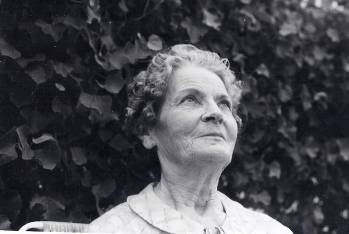
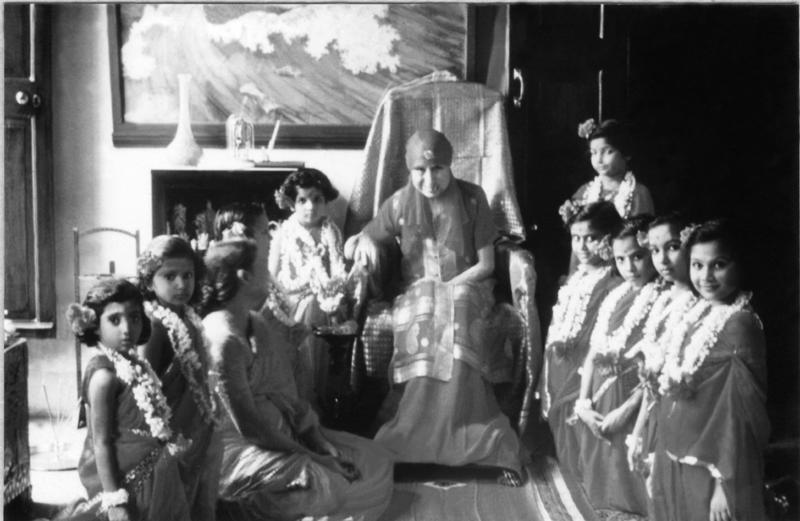
May 16 is the birth anniversary of beloved Jyotipriya, the founder of Sri Aurobindo Center of Los Angeles. Sri Aurobindo, her spiritual Guru, in whom she had taken refuge, gave her the name “Lover of Light” (Jyotipriya). This day every year fills us with gratitude for giving shape to the flame that is the Center, which inspires all connected with it towards a greater self-giving to the Divine. The luminous example of her life given to the service of the Mother and Sri Aurobindo shines as a guiding light to all aspirants.
Obviously to seek the Divine only for what one can get out of Him is not the proper attitude; but if it were absolutely forbidden to seek Him for these things, most people in the world would not turn towards Him at all. I suppose therefore it is allowed so that they may make a beginning—if they have faith, they may get what they ask for and think it a good thing to go on and then one day they may suddenly stumble upon the idea that this is after all not quite the one thing to do and that there are better ways and a better spirit in which one can approach the Divine. If they do not get what they want and still come to the Divine and trust in Him, well, that shows they are getting ready. Let us look on it as a sort of infants’ school for the unready. But of course that is not the spiritual life, it is only a sort of elementary religious approach. For the spiritual life to give and not to demand is the rule. The sadhak however can ask for the Divine Force to aid him in keeping his health or recovering it if he does that as part of his sadhana so that his body may be able and fit for the spiritual life and a capable instrument for the Divine Work.
Motives for Seeking the Divine, The Path of the Integral Yoga, Letters on Yoga – II, Sri Aurobindo.
The first necessity is the practice of concentration of your consciousness within yourself. The ordinary human mind has an activity on the surface which veils the real Self. But there is another, a hidden consciousness within behind the surface one in which we can become aware of the real Self and of a larger deeper truth of nature, can realise the Self and liberate and transform the nature. To quiet the surface mind and begin to live within is the object of this concentration. Of this true consciousness other than the superficial there are two main centres, one in the heart (not the physical heart, but the cardiac centre in the middle of the chest), one in the head. The concentration in the heart opens within and by following this inward opening and going deep one becomes aware of the soul or psychic being, the divine element in the individual. This being unveiled begins to come forward, to govern the nature, to turn it and all its movements towards the Truth, towards the Divine, and to call down into it all that is above. It brings the consciousness of the Presence, the dedication of the being to the Highest and invites the descent into our nature of a greater Force and Consciousness which is waiting above us. To concentrate in the heart centre with the offering of oneself to the Divine and the aspiration for this inward opening and for the Presence in the heart is the first way and, if it can be done, the natural beginning; for its result once obtained makes the spiritual path far more easy and safe than if one begins the other way.
That other way is the concentration in the head, in the mental centre. This, if it brings about the silence of the surface mind, opens up an inner, larger, deeper mind within which is more capable of receiving spiritual experience and spiritual knowledge. But once concentrated here one must open the silent mental consciousness upward to all that is above mind. After a time one feels the consciousness rising upward and in the end it rises beyond the lid which has so long kept it tied in the body and finds a centre above the head where it is liberated into the Infinite. There it begins to come into contact with the universal Self, the Divine Peace, Light, Power, Knowledge, Bliss, to enter into that and become that, to feel the descent of these things into the nature. To concentrate in the head with the aspiration for quietude in the mind and the realisation of the Self and Divine above is the second way of concentration. It is important, however, to remember that the concentration of the consciousness in the head is only a preparation for its rising to the centre above; otherwise, one may get shut up in one’s own mind and its experiences or at best attain only to a reflection of the Truth above instead of rising into the spiritual transcendence to live there. For some the mental concentration is easier, for some the concentration in the heart centre; some are capable of doing both alternately – but to begin with the heart centre, if one can do it, is the more desirable.
The Path and the Goal, The Path of the Integral Yoga, Letters on Yoga – II, Sri Aurobindo.
Only those years that are passed uselessly make you grow old.A year spent uselessly is a year during which no progress has been accomplished, no growth in consciousness has been achieved, no further step has been taken towards perfection.Consecrate your life to the realisation of something higher and broader than yourself and you will never feel the weight of the passing years.
Nov 19 1954
When a child lives in normal conditions, it has a spontaneous confidence that all it needs will be given to it.This confidence should persist, unshaken, throughout life; but the limited idea, ignorant and superficial, of its needs which a child has, must be replaced progressively by a wider, deeper and truer conception which culminates in the perfect conception of needs in accordance with the supreme wisdom, until we realise that the Divine alone knows what our true needs are and rely upon Him for everything.
Messages, Letters and Conversations, On Education, Vol 12, CWM, The Mother.
The spiritual aim will recognise that man as he grows in his being must have as much free space as possible for all its members to grow in their own strength, to find out themselves and their potentialities. In their freedom they will err, because experience comes through many errors, but each has in itself a divine principle and they will find it out, disengage its presence, significance and law as their experience of themselves deepens and increases. Thus true spirituality will not lay a yoke upon science and philosophy or compel them to square their conclusions with any statement of dogmatic religious or even of assured spiritual truth, as some of the old religions attempted, vainly, ignorantly, with an unspiritual obstinacy and arrogance. Each part of man’s being has its own dharma which it must follow and will follow in the end, put on it what fetters you please. The dharma of science, thought and philosophy is to seek for truth by the intellect dispassionately, without prepossession and prejudgment, with no other first propositions than the law of thought and observation itself imposes. Science and philosophy are not bound to square their observations and conclusions with any current ideas of religious dogma or ethical rule or aesthetic prejudice. In the end, if left free in their action, they will find the unity of Truth with Good and Beauty and God and give these a greater meaning than any dogmatic religion or any formal ethics or any narrower aesthetic idea can give us. But meanwhile they must be left free even to deny God and good and beauty if they will, if their sincere observation of things so points them. For all these rejections must come round in the end of their circling and return to a larger truth of the things they refuse. Often we find atheism both in individual and society a necessary passage to deeper religious and spiritual truth: one has sometimes to deny God in order to find him; the finding is inevitable at the end of all earnest scepticism and denial.
The Spiritual Aim and Life, The Human Cycle, CWSA, Sri Aurobindo.