Power of mental formation – II. The Mother

Is it right to see images when one meditates, as for example, a door opening?

     Everything is right, if it has a result. Whatever the means it is all right. Why ? The images you speak of are not necessarily ridiculous; they are mental images, and if they produce a result they are quite appropriate, if they give you an experience, they are appropriate.

     Everyone has his special procedure. Some may have imageries that help them; some, on the contrary, have a more abstract spirit and see ideas only, others again, they who live more in their sensations and feelings, have rather psychological movements, movements of inner feeling and sensation; that depends on each one. Those who have an active, a “form-making” mind, are particularly those who see images, but everybody does not experience tie same thing. Generally, it is more often a sensation, a feeling than an image.

When, for example, I ask you to descend into yourself, some will concentrate on a sensation, but others will have the impression of going down into a well and these have absolutely the image’of steps descending into a dark and deep well and they descend more and more, more and more, and sometimes they do arrive at a door : they sit down before the door with the will to enter and sometimes the door opens, then they enter and see something like a hall or a room or a grotto, and from there if they continue they can arrive at another door and again stop, and with an effort this door also opens and you can go farther and if you do it with sufficient persistence and can continue the experience, there comes a moment when you find yourself before a door which has a special quality of solidity or solemnity and with a great effort of concentration the door opens and you enter into a chamber of light; then you have the experience of the contact of your soul…I do not see what is there bad in having images.

But it is only an imagination, is it not, Mother ?

Imagination ? What is an imagination ? You can imagine nothing that does not exist in the universe. It is impossible to imagine something that does not exist somewhere. The only thing is that you do not put your imagination in its place, or you give it virtues and qualities that it has not or you explain it otherwise than by a good explanation. But whatever you imagine exists somewhere, the only thing is to know where and to put it in its right place.

Naturally, if having imagined that you were before a door, you thought that it was really a physical door that is within your body, then it would be an error; but if you note that it is a mental form taken by your effort for concentration, that is quite correct.

If you take a walk in the mental world, you will find it full of forms like that, all kinds of forms which have no material reality but which exist perfectly well in the mental world.

You cannot think strongly of anything without your thought taking a form.

Imagination is a power of formation. In fact, those who have no imagination are the people who do not create forms in the mental plane, who cannot give a concrete power to their thought. Imagination is a very powerful means of action. For example, if you have a pain somewhere and if you can imagine that you are making it disappear or removing it or destroying it with the help of some images, well, you succeed perfectly well.

The story is told of a person who was losing her hair in a fantastic way and was threatened with baldness in a few weeks. Then someone told her, “Just imagine, when you do your hair, that they are growing and will grow very quickly. And the person while combing her hair was always saying, “Oh, my hair is growing, oh, it is growing very quickly !” And in fact, that is what happened. But what people generally do is to say, “Ah, all my hairs are falling and I am getting bald. It is sure, that is going to happen”. Evidently that is what does happen.

What is to be done to discipline the imagination ?

What is vaguely called imagination is a very complex, varied thing.

It is perhaps the capacity to see and record, to note the forms that are in one mental domain or another. There are artistic domains, literary domains, poetical domains, domains of action, scientific domains all belonging to the mind, not the higher or very abstract mind, but a mind which is above the physical mind and which, without our knowing it, constantly pours itself out through the individual and collective mind to manifest in action.

Some persons, because of a special capacity, are in relation with these domains and they take up one of these formations that are there, hold to them and give them an expression. This power of expression is different in different people, but those who have the capacity to open themselves to these domains, to see there and draw these forms to themselves and express them whether in literature, in painting, in action or in the sciences are, to the degree of their power of expression, great talents or geniuses.

      There are higher geniuses. They are those who can open themselves to a higher region, to a higher force that passes through the mental levels and takes form in some human mind and manifests in the world as a new truth, a new philosophical system, a new spiritual teaching; then you have the works, as well as the actions of great beings who come to take birth on earth. It is an imagination that might be called an imagination of the Truth.

      These higher forces, when they descend into earth’s atmosphere, take forms that are living, active, powerful and spread upon the world and prepare new times. These two kinds of imagination are what one might call higher imaginations.

To come down again to a more ordinary level, everyone has in himself, in a greater or lesser measure, the capacity to give a form to his mental activity and to use this form either in ordinary activities or to create and realise something. We are always all the while creating images, creating forms. We send them into the atmosphere without even knowing that we are doing it. They go about, pass from one to another, they meet companions, sometimes associate together and live happily together, sometimes they come into conflict and there are battles, for often, very often, there is in these mental imaginations an element of will that seeks to realise itself and as each one sends out his formation so that it may act and things happen as he desires, that makes a general confusion. If our eyes were open to the vision of all these forms in the atmosphere we would see very astonishing things, battle-fields, waves, onsets, withdrawals of a large number of small mental entities that are constantly thrown into the air and that always try to realise themselves. All these formations have one common urge, the will to materialise, to realise themselves physically, and as they are innumerable, there is not sufficient room upon earth for all of them to be able to manifest themselves; so they push one another, elbow one another; we try to push out those that do not agree with us or even we form armies that march in good order, always to take all available place in space and time; and it is a very small place in comparison with the innumerable quantity of creations.

There are those that make formations without knowing it, — everybody, — and who are constantly hustled from one thing to another, who hope, want, desire, are disappointed, sometimes satisfied, sometimes in despair, because they have no control or mastery over these things. But the beginning of wisdom is to see oneself thinking, to look at this phenomenon and to perceive this constant projection into the atmosphere of small living entities that try to manifest themselves; all that occurs in the mental atmosphere that we carry in us. Once we see and observe, we can then begin to sift, that is to say, drive away what is not in agreement with our will or our highest aspiration, allowing to manifest only those formations which can help us to progress, to grow normally. That is the control of active thought.

      How often you sit down and see your thought begin to form into images, narrate a story; and when you are a little expert, not only do you see the story of what you would like to happen in life, in your own life unrolling itself, but you can cut down one thing, add a detail, perfect your work, make a fine story in which everything agrees with your best aspiration, and once you have made a construction harmonious, complete, as perfect as you can, then you open your hands and let the bird fly.

 And if it is well done, it ends always by realising itself. And one does not know that.

But the thing realises itself in course of time, sometimes long after; then when you have forgotten your story, when you no more remember to have told it to yourself and you have changed much, you think of other things, you make other stories and the previous one interests you no more, and if you are not very attentive, when the result of the first story comes, you are far away from it, you do not remember at all that it was the result of your own story. That is why it is so important to control oneself, because if there are within you multiple and contradictory wills, — not only wills, but tendencies, trends, planes of life that are opposed to each other, that makes battles in your life. For example, when you are on the highest level, you make a fine story and send it out into the world, but on the next day or perhaps on the very day, perhaps sometimes after, you have come down into a much more material level and the things up there appear a little.. .fairy-tale like, unreal and you begin to make formations very concrete, very useful and they are not always very pretty and those too go abroad.

       I knew persons who had in their nature sides so opposite, so contradictory that one day they may make a formation that is magnificent, luminous, powerful, effective and the next day, a formation defeatist, dark, black, a formation of despair, — and then both fly away. And I could follow under the circumstances the beautiful thing that was realising itself and the dark thing that was demolishing what the other had made as it realised itself. Things happen like that in the general lines of life, as well as in the little details. All that, because you do not see yourself thinking, because you believe you are slaves of your contradictory movements, because you say, “Oh, today, I do not feel well. Oh, today things appear sad”, and you say that as if it were an inevitable fatality. But if you go back one step or if you get up one rung, you can look at all these things, put them in their place, retain, destroy or drive away that which you do not want and put all your force of imagination into those that you do want and which agree with your highest aspiration. That is what I call controlling one’s imagination.

       It is very interesting. When you learn to do that and when you do it regularly, time no longer hangs heavy on you.

       And instead of being like a cork floating on the waves, cast about helplessly here and there by each wave, without defence, you become a bird that opens its wings, flies over the waves, goes wherever it likes.
Posted in Life, Mind, Travelling the Path | Leave a comment

Power of mental formation – Mother

Power of Imagination  

The imagination is really the power of mental formation. When this power is put at the service of the Divine, it is not only formative but also creative. There is, however, no such thing as an unreal formation, because every image is a reality on the mental plane. The plot of a novel, for instance, is all there on the mental plane existing independently of the physical. Each of us is a novelist to a certain extent and possesses the capacity to make forms on that plane; and, in fact, a good deal of our life embodies the products of our imagination. Every time you indulge your imagination in an unhealthy way, giving a form to your fears and anticipating accidents and misfortunes, you are undermining your own future. On the other hand, the more optimistic your imagination, the greater the chance of your realising your aim. Monsieur Coué got hold of this potent truth and cured hundreds of people by simply teaching them to imagine themselves out of misery. He once related the case of a lady whose hair was falling off. She began to suggest to herself that she was improving every day and that her hair was surely growing. By constantly imagining it her hair really began to grow and even reached an enviable length owing to still further auto-suggestion. The power of mental formation is most useful in Yoga also; when the mind is put in communication with the Divine Will, the supramental Truth begins to descend through the layers intervening between the mind and the highest Light and if, on reaching the mind, it finds there the power of making forms it easily becomes embodied and stays as a creative force in you. Therefore I say to you never be dejected and disappointed but let your imagination be always hopeful and joyously plastic to the stress of the higher Truth, so that the latter may find you full of the necessary formations to hold its creative light.

The imagination is like a knife which may be used for good or evil purposes. If you always dwell in the idea and feeling that  you are going to be transformed, then you will help the process of the Yoga. If, on the contrary, you give in to dejection and bewail that you are not fit or that you are incapable of realisation, you poison your own being. It is just on account of this very important truth that I am so tirelessly insistent in telling you to let anything happen but, for heavens sake, not to get depressed. Live rather in the constant hope and conviction that what we are doing will prove a success. In other words, let your imagination be moulded by your faith in Sri Aurobindo; for, is not such faith the very hope and conviction that the will of Sri Aurobindo is bound to be done, that his work of transformation cannot but end in a supreme victory and that what he calls the supramental world will be brought down on earth and realised by us here and now?

Posted in Mind | Comments Off on Power of mental formation – Mother

The Truth about our difficulties – Mother

Sri Aurobindo writes here: “… Few and brief in their  visits are the Bright Ones who are willing or permitted to succour.”¹Why ?

One must go and ask them ! But there is a conclusion, the last sentences give a very clear explanation. It is said: “Nay, then, is immortality a plaything to be given lightly to a child, or the divine life a prize without effort or the crown for a weakling ?” This comes back to the question why the adverse forces have the right to interfere, to harass you. But this is precisely the test necessary for your sincerity. If the way were very easy, everybody would start on the way, and if one could reach the goal without any obstacle and without any effort, everybody would reach the goal, and when one has come to the end, the situation would be the same as when one started, there would be no change. That is, the new world would be exactly what the old has been. It is truly not worth the trouble! Evidently a process of elimination is necessary so that only what is capable of manifesting the new life remains. This is the reason and there is no other, this is the best of reasons. And, you see, it is a tempering, it is the ordeal of fire, only that which can stand it remains absolutely pure; when everything has burnt down, there remains only the little ingot of pure gold. And it is like that. What puts things out very much in all this is the religious idea of fault, sin, redemption. But there is no arbitrary decision! On the contrary, for each one it is the best and most favourable conditions which are given. We were saying the other day that it is only his friends whom God treats with severity; you thought it was a joke, but it is true. It is only to those who are full of hope, who will pass through this purifying flame, that the conditions for attaining the maximum result are given. And the human mind is made in such a way that you may test this; when something extremely unpleasant happens to you, you may tell yourself, “Well, this proves I am worth the trouble of being given this difficulty, this proves there is something in me which can resist the difficulty”, and you will notice that instead of tormenting yourself, you rejoice – you will be so happy and so strong that even the most unpleasant things will seem to you quite charming! This is a very easy experiment to make. Whatever the circumstance, if your mind is accustomed to look at it as something favourable, it will no longer be unpleasant for you. This is quite well known; as long as the mind refuses to accept a thing, struggles against it, tries to obstruct it, there are torments, difficulties, storms, inner struggles and all suffering. But the minute the mind says, “Good, this is what has to come, it is thus that it must happen”, whatever happens, you are content. There are people who have acquired such control of their mind over their body that they feel nothing; I told you this the other day about certain mystics: if they think the suffering inflicted upon them is going to help them cross the stages in a moment and give them a sort of stepping-stone to attain the Realisation, the goal they have put before them, union with the Divine, they no longer feel the suffering at all. Their body is as it were galvanised by the mental conception. This has happened very often, it is a very common experience among those who truly have enthusiasm.

Posted in Life | Leave a comment

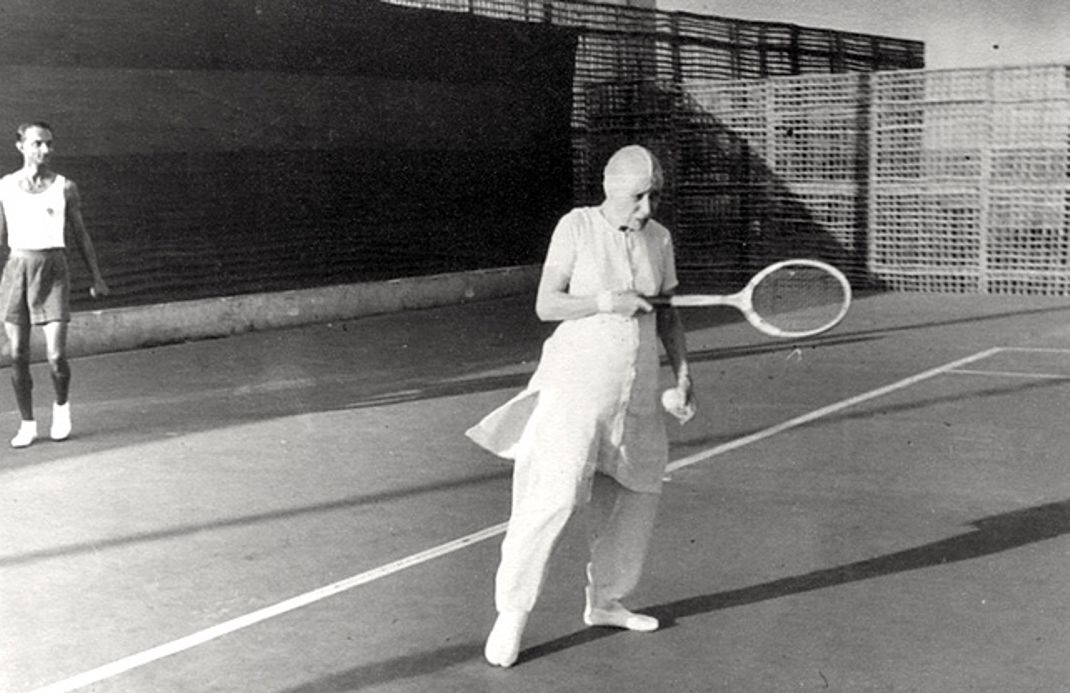
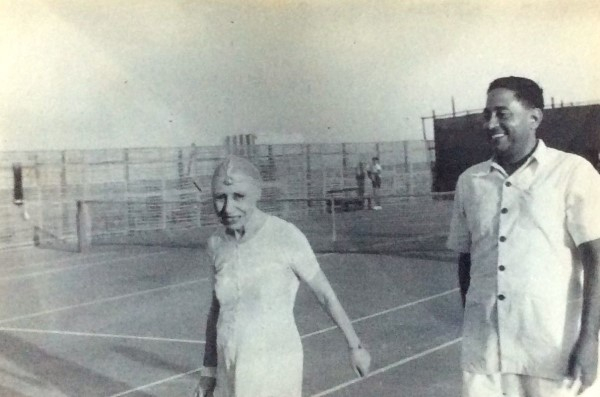
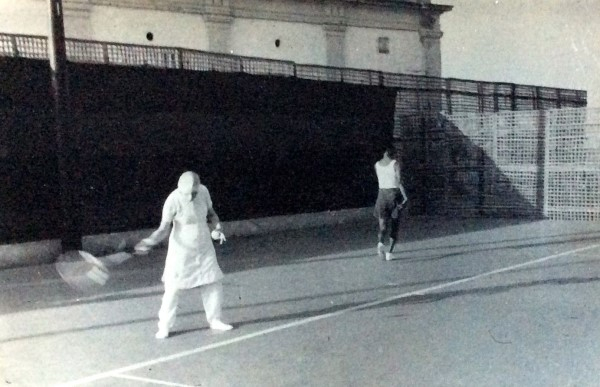
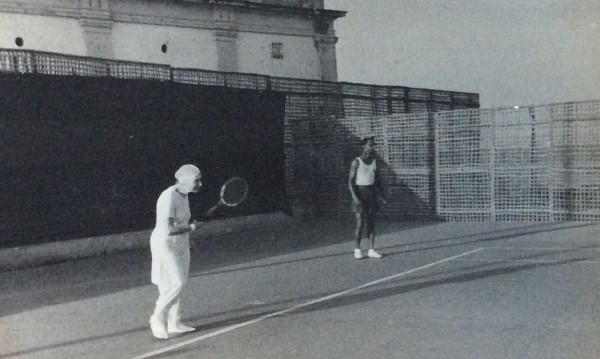
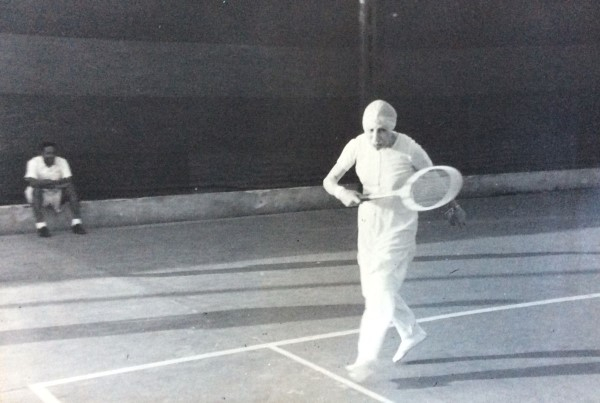
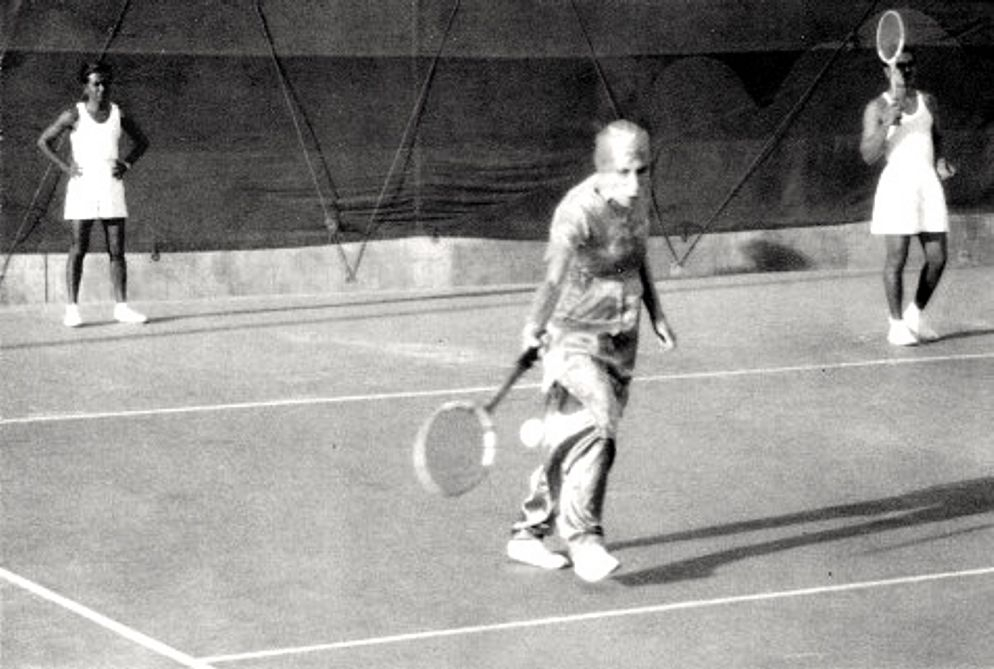
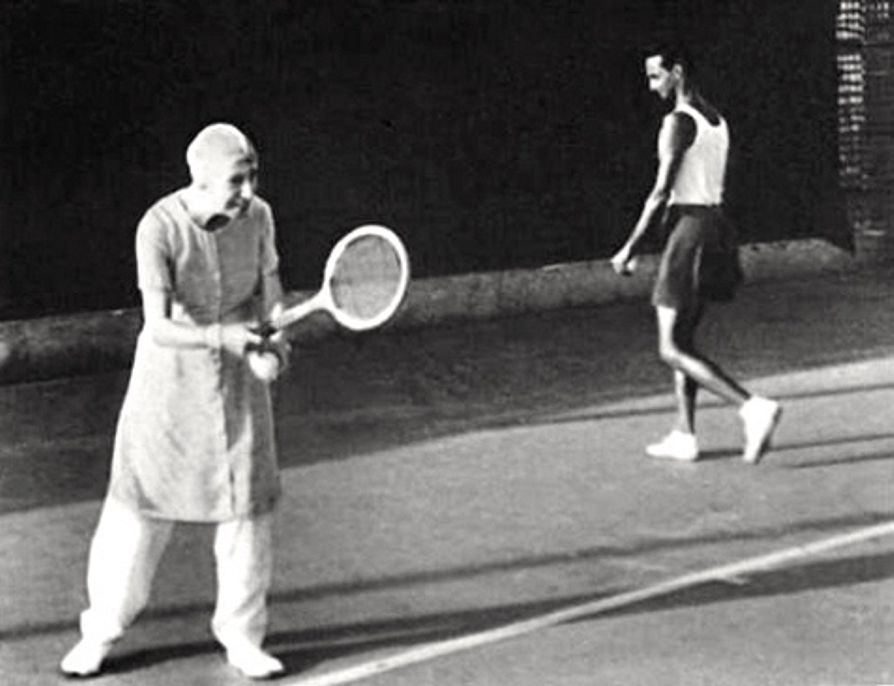
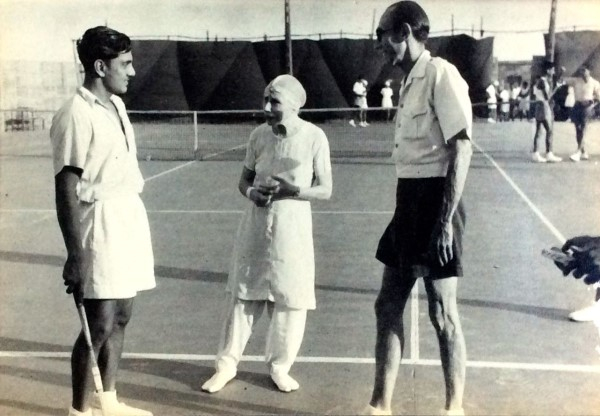
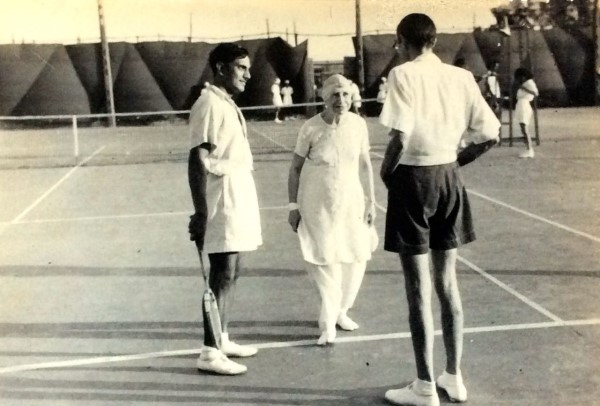
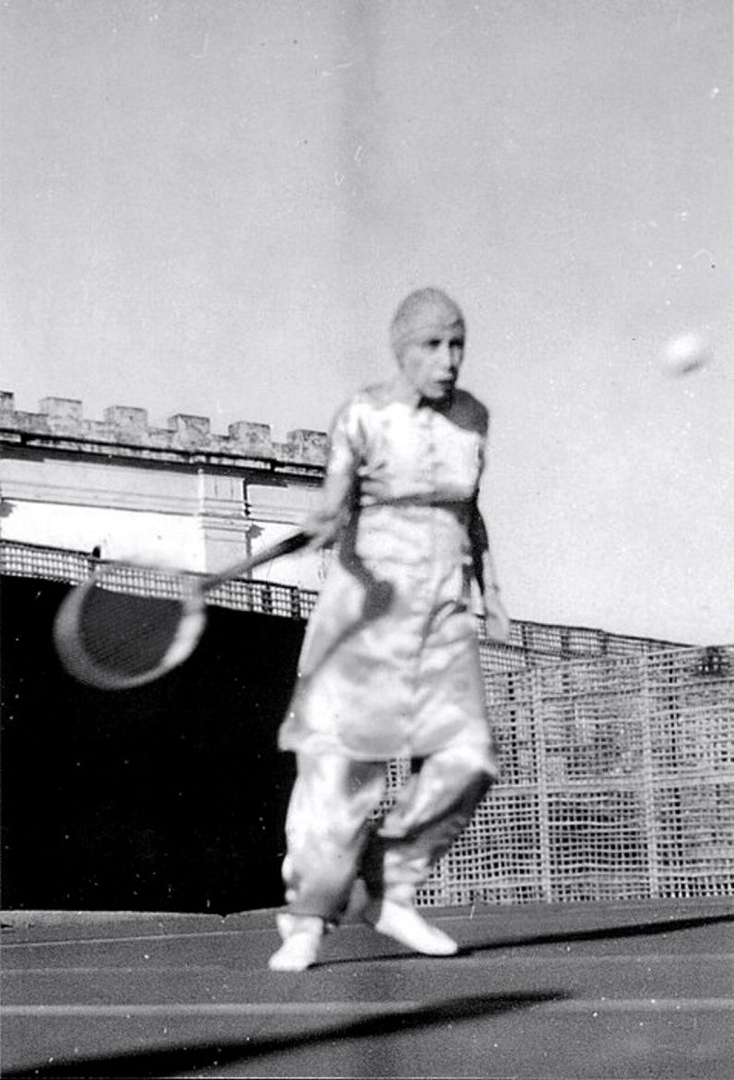
The Mother’s Playground


Ma-Tennis-1

For even the close partners of her thoughts
Who could have walked the nearest to her ray,
Worshipped the power and light they felt in her
But could not match the measure of her soul.


Ma-Tennis-13


She had come into the mortal body’s room
To play at ball with Time and Circumstance.
A joy in the world her master movement here,
The passion of the game lighted her eyes:


Ma-Tennis-10A marriage with eternity divinised Time.
There Life pursued unwearied of her sport
Joy in her heart and laughter on her lips,
The bright adventure of God’s game of Chance.


Ma-Tennis-9

Her look, her smile awoke celestial sense
Even in earth-stuff, and their intense delight
Poured a supernal beauty on men’s lives.


Ma-Tennis-6


The omniscient Goddess leaned across the breadths
That wrap the fated journeyings of the stars
And saw the spaces ready for her feet.


Ma-Tennis-8

The little plot of our mortality
Touched by this tenant from the heights became
A playground of the living infinite.


Ma-Tennis-4


A cry and leap and hurry were around,

The stealthy footfalls of her chasing things,


Ma-Tennis-17

Invaded by beauty’s universal revel
Her being’s fibre reached out vibrating
And claimed deep union with its outer selves,


Ma-Tennis-16


The fluctuating chance turns of her mood,

Works out her meanings she seems not to know

And serves her secret purpose in long Time.


Ma-Tennis-2


Her measure they could not reach but bore her touch,
Answering with the flower’s answer to the sun
They gave themselves to her and asked no more.

Posted in The Mother | 3 Comments

Traveling the Path – The right thing in the right way.

Pray to the Divine Grace to make you do always the right thing in the right way.
Always do what you know to be the best even if it is the most difficult thing to do.
– Mother
2 May 1954

image022

Posted in Thoughts to ponder, Travelling the Path | Leave a comment

Proceeding on the Path. Get quiet and establish Peace in the being.

The physical consciousness is not only the consciousness of our body, but of all that surrounds us as well all that we perceive with our senses. It is a sort of apparatus for recording and transmission which is open to all the contacts and shocks coming from outside and responds to them by reactions of pleasure and pain which welcome or repel. This makes in our outer being a constant activity and noise that we are only partially aware of, because we are so accustomed to them.

 But if through meditation or concentration we turn inward or upward, we can bring down into ourselves or raise up from the depths calm, quiet, peace and finally silence. It is a concrete, positive silence (not the negative silence of the absence of noise), immutable so long as it remains, a silence one can experience even in the outer tumult of a hurricane or battlefield. This silence is synonymous with peace and it is all-powerful; it is the perfectly effective remedy for the fatigue, tension and exhaustion arising from that internal over-activity and noise which generally escape our control and cease neither by day nor night.

This is why the first thing required when one wants to do Yoga is to bring down and establish in oneself the calm, the peace, the silence.  

Some Answers from the Mother Volume-16.

 15 October 1959

Posted in Life, Mind, Travelling the Path | Leave a comment

Significance of the Relics of Sri Aurobindo.

Significance of the Relics

The institution of Relics is ancient. It is not a part of religion though it may enter into the system of rituals in some way or other. It is based on a sound principle of consciousness. We have known the tradition of not using things associated with men of evil. Objects used by them or owned by them, carry the taint of evil and communicate it to those who come into possession of them. So also things belonging to those with a broken destiny are known to carry a strong negative force in them. These facts are well known in occult circles and something of this knowledge has percolated in the common traditions of the people.

The reverse is equally true, perhaps more true. Things used by developed persons imbibe the consciousness of the person concerned. The quality of the person permeates the object. This is specially so with holy persons, spiritual personalities. Their consciousness is of a high order, with special potency and whatever has been handled by them for long is instinct with their power. The consciousness of a God-realized person is of a distinct kind; it is eternal, divine. If the objects associated with such a person carry the charge of his consciousness, it is much more so with anything that forms part of his body. Each part absorbs continuously the consciousness that is housed in the body. That is why in our spiritual   tradition those who have attained to divinity are not cremated. When they pass away, their bodies are buried so as to preserve their divine vibrations for the good of the world. That explains why Sannyasins are not cremated; they are supposed to have absorbed divine vibrations in consciousness. Of course some saints expressly leave instructions for cremation, that is a different matter.

This is the broad background. We have known in history the importance paid to the Tooth of the Buddha. It is not any religious superstition that sways the masses. There is a sound spiritual truth underlying the institution. Sri Aurobindo, as all know, went beyond the traditional God-realization state, the jivanmukti realization. Basing himself upon it, he worked to invoke and embody the highest Truth-Consciousness in himself in order to establish it on Earth for the benefit of mankind. In other words he strove to divinize his physical body. A distinctive testimony to this feature of his life was provided by the unique fact that even after he withdrew from his physical body, it continued to emanate the glow of the supramental consciousness; the body would not disintegrate for full five days. Naturally his vibrations continue to emanate from the Samadhi where his body has been interred.  Nobody can escape this impact in the environs of the Samadhi.

Luckily for us, some precious parts of his body like hair, nails, have been preserved by Champaklalji who was personally attending on him. They were collected and preserved down the years with tender care and love. The Mother has charged them further with additional Supramental force so that they may communicate their consciousness to all without fail. It is these parts of Sri Aurobindo’s person that are now cherished and carried to distant shrines as Relics. Where these Relics are, there Sri Aurobindo’s physical presence is. We have experienced this even in far off places like London, Florida, where the Relics have been established in special shrines.

It is not enough to open such shrines. The special atmosphere created by the Relics must be tended, preserved, by the devotees. They have to contribute their aspiration, purity and consecration so as to guard the sanctity against dilution, pollution. Sri Aurobindo is physically present in these Centers and it is a great responsibility to uphold the sanctity by maintaining high standards of purity around. Sri Aurobindo Shrine is not in the common run of a temple looked after by a priest. It is vibrant focus of a special spiritual Force that has been brought down from the world of Light on Earth to guide and lead its Journey to the Sun of Truth. Properly tended, the Shrine grows in its radiation, it remains ever-new.

M.P Pandit.

Posted in Sri Aurobindo | 1 Comment

Is Nature Intelligent?

What is this Nature of which we speak so fluently? We habitually talk of it as if it were something mighty and conscious that lives and plans; we credit it with an aim, with wisdom to pursue that aim and with power to effect what it pursues. Are we justified in our language by the actualities of the universe or is this merely our inveterate habit of applying human figures to non-human things and the workings of intelligence to non-intelligent processes which come right because they must and not because they will and produce this magnificent ordered universe by some dumb blind and brute necessity inconceivable in its origin and nature to intelligent beings? If so, this blind brute force has produced something higher than itself, something which did not exist preconceived in its bosom or in any way belong to it. We cannot understand what being and Nature are, not because we are as yet too small and limited, but because we are too much above being and Nature. Our intelligence is a luminous freak in a darkness from which it was impossibly produced, since nothing in that darkness justified itself as a cause of its creation. Unless mind was inherent in brute matter,—and in that case matter is only apparently brute,—it was impossible for matter to produce mind. But since this leads us to an impossibility, it cannot be the truth. We must suppose then, if matter is brute, that mind is also brute. Intelligence is an illusion; there is nothing but a shock of material impacts creating vibrations and reactions of matter which translate themselves into the phenomena of intelligence. Knowledge is only a relation of matter with matter, and is intrinsically neither different nor superior to the hurtling of atoms against each other or the physical collision of two bulls in a meadow. The material agents involved and phenomenon produced are different and therefore we do not call the recoil of one horned forehead from another an act of knowledge or intelligence, but the thing that has happened is intrinsically the same. Intelligence is itself inert and mechanical and merely the physiological result of a physiological movement and has nothing in it psychical or mental in the time-honoured sense of the words soul and mind. This is the view of modern scientific rationalism,—put indeed in other language than the scientist’s, put so as to bring out its logical consequences and implications, but still effectively the modern account of the universe.
In that account the nature of a thing consists of its composition, the properties contained in that composition and the laws of working determined by those properties; as for [example] iron is composed of certain elementary substances, possesses as a consequence of its composition certain properties, such as hardness etc. and under given circumstances will act in a given manner as the result of its properties. Applying this analysis on a larger scale we see the universe as the composition of certain brute forces working in certain material substances, possessed in itself and in those substances of certain primary and secondary, general and particular properties and working as a result by certain invariable tendencies and fixed processes which we call by a human figure Nature’s Laws. This is Nature. When searchingly analysed she is found to be a play of two entities, Force and Matter; but these two, if the unitarian view of the universe is correct, will some day be proved to be only one entity, either only Matter or only Force.
Even if we accept this modern view of the universe, which, it is not at all dangerous to prophesy, will have disappeared in the course of a century into a larger synthesis, there is still something to be said about the presence or absence of intelligence in Nature. In what after all does intelligence consist, what are its composition, properties, laws? What in its circumstances is human intelligence, the only kind of intelligence which we are in a position to study from within and therefore understand? It is marked by three qualities or processes, the power and process of adaptation towards an end, the power and process of discrimination between the impacts on its senses and the power and process of mentally conscious comprehension. Human intelligence is, to put it briefly, teleological, discriminative and mentally conscious. About other than human beings, about animals, trees, metals, forces, we can say nothing from inside, we can only infer the absence or presence of these elements of consciousness from the evidence collected by an external observation. We cannot positively say, having no internal evidence, that the tree is not a mind imprisoned in matter and unable to express itself in the media it has at its disposal; we cannot say that it does not suffer the reactions of pleasure and pain; but from the external evidence we infer to the contrary. Our negative conclusion is probable, it is not certain. It may be itself negatived in the future march of knowledge. But still, taking the evidence as it stands, what are the facts we actually arrive at in this comparison of intelligent and non-intelligent Nature?
First, Nature possesses in a far higher degree than man the teleological faculty and process. To place an aim before one, to combine, adapt, modify, unify, vary means and processes in order to attain that end, to struggle against and overcome difficulties, to devise means to circumvent difficulties when they cannot be overcome, this is one of the noblest and divinest parts of human intelligence. But its action in man is only a speciality of its universal action in Nature. She works it out in man partly through the reason, in animals with very little and rudimentary reason, mainly through instinct, memory, impulse and sensation, in plants and other objects with very little and rudimentary reason, mainly through impulse and mechanical or, as we call it, involuntary action. But throughout there is the end and the adaptation to the end, and throughout the same basic means are used; for in man also it is only for a selection of his ends and processes that the reason is used; for the greater part she uses the animal means, memory, impulse, sensation, instinct,—instincts differently directed, less decisive and more general than the animal instincts but still in the end and for their purpose as sure; and for yet another part she uses the same merely mechanical impulse and involuntary action precisely as in her mistermed inanimate forms of existence. Let us not say that the prodigality of Nature, her squandering of materials, her frequent failure, her apparent freaks and gambollings are signs of purposelessness and absence of intelligence. Man with his reason is guilty of the same laches and wanderings. But neither Man nor Nature is therefore purposeless or unintelligent. It is Nature who compels Man himself to be other than too strenuously utilitarian, for she knows better than the economist and the utilitarian philosopher. She is an universal intelligence and she has to attend, not only in the sum, but in each detail, to the universal as well as to the particular effect; she has to work out each detail with her eye on the group and not only on the group but the whole kind and not only on the whole kind but the whole world of species. Man, a particular intelligence limited by his reason, is incapable of this largeness; he puts his particular ends in the forefront and neither sees where absorption in them hurts his general well being nor can divine where they clash with the universal purpose. Her failures have an utility—we shall see before long how great an utility; her freaks have a hidden seriousness. And yet above all she remembers that beyond all formal ends, her one great object is the working out of universal delight founded on arrangement as a means, but exceeding its means. Towards that she moves; she takes delight on the way, she takes delight in the work, she takes delight, too, beyond the work.
But in all this we anticipate, we speak as if Nature were self-conscious; what we have arrived at is that Nature is teleological, more widely than man, more perfectly than man, and man himself is only teleological because of that in Nature and by the same elementary means and processes as the animal and the plant, though with additions of fresh means peculiar to mind. This, it may be said, does not constitute Intelligence,—for intelligence is not only teleological, but discriminative and mentally conscious. Mechanical discrimination, Nature certainly possesses in the highest degree; without it her teleological processes would be impossible. The tendril growing straight through the air comes into contact with a rope, a stick, the stalk of a plant; immediately it seizes it as with a finger, changes its straight growth for a curled and compressive movement, and winds itself round and round the support. What induces the change? what makes it discriminate the presence of a support and the possibility of this new movement? It is the instinct of the tendril and differs in no way, intrinsically, from the instinct of the newborn pup seizing at once on its mother’s teats or the instinct of a man in his more mechanical needs and actions. We see the moon-lotus open its petals to the moon, close them to the touch of the day. In what does this discriminative movement differ from the motion of the hand leaping back from the touch of a flame, or from the recoiling movement of disgust and displeasure in the nerves from an abhorrent sight or from the recoiling movement of denial and uncongeniality in the mind from a distasteful idea or opinion? Intrinsically, there seems to be no difference; but there is a difference in circumstance. One is not attended with mental self-consciousness, the others are attended with this supremely important element. We think falsely that there is no will in the action of the tendril and the lotus, and no discrimination. There is a will, but not mentalised will; there is discrimination but not mentalised discrimination. It is mechanical, we say,—but do we understand what we mean when we say it,— we give other names, calling will force, discrimination a natural reaction or an organic tendency. These names are only various masks concealing an intrinsic identity.
Even if we could go no farther, we should have gained an enormous step; for we have already the conception of the thing we call Nature as possessing, containing or identical with a great Force of Will placing before itself a vast end and a million complexly related incidental ends, working them out by contrivance, adaptation, arrangement, device, using an unfailing discrimination and vastly fulfilling its complex work. Of this great Force human intelligence would only be a limited and inferior movement, guided and used by it, serving its ends even when it seems to combat its ends. We may deny Intelligence to such a Power, because it does not give signs of mental consciousness and does not in every part of its works use a human or mental intelligence; but our objection is only a metaphysical distinction. Practically, looking out on life and not in upon abstract thought, we can, if we admit this conception, rely on it that the workings of this unintelligent discrimination will be the same as if they were the workings of a universal Intelligence and the aim and means of the mechanical will the aims and means which would be chosen by an Almighty Wisdom. But if we arrive at this certainty, does not Reason itself demand of us that we should admit in Nature or behind it a universal Intelligence and an Almighty Wisdom? If the results are such as these powers would create, must we not admit the presence of these powers as the cause? Which is the truer Rationalism, to admit that the works of Intelligence are produced by Intelligence or to assert that they are produced by a blind Machine unconsciously working out perfection? to admit that the emergence of overt intelligence in humanity is due to the specialised function of a secret intelligence in the universe or to assert that it is the product of a Force to which the very principle of Intelligence is absent? To justify the paradox by saying that things are worked out in a particular way because it is their nature to be worked out in that way, is to play the fool with reason; for it does not carry us an inch beyond the mere fact that they are so worked out, one knows not why.
The true reason for the modern reluctance to admit that Nature has intelligence and wisdom or is intelligence and wisdom, is the constant association in the human mind of these things with mentally self-conscious personality. Intelligence, we think, presupposes someone who is intelligent, an ego who possesses and uses this intelligence. An examination of human consciousness shows that this association is an error. Intelligence possesses us, not we intelligence; intelligence uses us, not we intelligence. The mental ego in man is a creation and instrument of intelligence and intelligence itself is a force of Nature manifesting itself in a rudimentary or advanced state in all animal life. This objection, therefore, vanishes. Not only so, but Science herself by putting the ego in its right place as a product of mind has shown that Intelligence is not a human possession but a force of Nature and therefore an attribute of Nature, a manifestation of the universal Force.
The question remains, is it a fundamental and omnipresent attribute or only a development manifested in a select minority of her works? Here again, the difficulty is that we associate intelligence with an organised mental consciousness. But let us look at and interrogate the facts which Science has brought into our ken. We will glance at only one of them, the fly catching plant of America. Here is a vegetable organism which has hunger,—shall we say, an unconscious hunger, which needs animal food, which sets a trap for it, as the spider sets it, which feels the moment the victim touches the trap, which immediately closes and seizes the prey, eats and digests it and lies in wait for more. These motions are exactly the motions of the spider’s mental intelligence altered and conditioned only by the comparative immobility of the plant and confined only, so far as we can observe, to the management of this supreme vital need and its satisfaction. Why should we attribute mental intelligence to the spider and none to the plant? Granted that it is rudimentary, organised only for special purposes, still it would seem to be the same natural Force at work in the spider and plant, intelligently devising means to an end and superintending the conduct of the device. If there is no mind in the plant, then, irresistibly, mental intelligence and mechanical intelligence are one and the same thing in essence, and the tendril embracing its prop, the plant catching its prey and the spider seizing its victim are all forms of one Force of action, which we may decline to call Intelligence if we will, but which is obviously the same thing as Intelligence. The difference is between Intelligence organised as mind, and Intelligence not organised but working with a broad elementary purity more unerring, in a way, than the action of mind. In the light of these facts the conception of Nature as infinite teleological and discriminative Force of Intelligence unorganised and impersonal because superior to organisation and personality becomes the supreme probability, the mechanical theory is only a possibility. In the absence of certainties Reason demands that we should accept the probable in preference to the possible and a harmonious and natural in preference to a violent and paradoxical explanation.
But is it certain that in this Intelligence and its works Mind is a speciality and Personality—as distinguished from mental ego—is entirely absent except as an efflorescence and convenience of Mind? We think so, because we suppose that where there are no animal signs of consciousness, there consciousness cannot and does not exist. This also may be an assumption. We must remember that we know nothing of the tree and the stone except its exterior signs of life or quiescence; our internal knowledge is confined to the phenomena of human psychology. But even in this limited sphere there is much that should make us think very deeply and pause very long before we hasten to rash negative assertions. A man sleeps, dreamlessly, he thinks; but we know that all the time consciousness is at work within him, dreaming, always dreaming; of his body and its surroundings he knows nothing, yet that body is of itself conducting all the necessary operations of life. In the man stunned or in trance there is the same phenomenon of a divided being, consciousness mentally active within apart from the body which is mentally even as the tree and the stone, but vitally active and functioning like the tree. Catalepsy presents a still more curious phenomenon of a body dead and inert like the stone, not even vitally active like the tree, but a mind perfectly aware of itself, its medium and its surroundings, though no longer in active possession of the medium and therefore no longer able to act materially on its surroundings. In face of these examples how can we assert that there is no life in the stone, no mind in stone or tree? The premise of the syllogism by which science denies mind to the tree or life to the stone, viz that where there is no outward sign of life or conscious mentality, life and mentality do not exist, is proven to be false. The possibility, even a certain probability presents itself,—in view of the unity of Nature and the omnipresent intelligence in her works, that the tree and the stone are in their totality just such a divided being, a form not yet penetrated and possessed by conscious mind, a conscious intelligence within dreaming in itself or, like the cataleptic, aware of its surroundings, but because not yet possessed of its medium (the intelligence in the cataleptic is temporarily dispossessed) unable to show any sign of life or of mentality or to act aggressively on its surroundings.
We do not need to stop at this imperfect probability, for the latest researches of psychology make it almost overwhelming in its insistence and next door to the actual proof. We now know that within men there is a dream self or sleep self other than the waking consciousness, active in the stunned, the drugged, the hypnotised, the sleeping, which knows what the waking mind does not know, understands what the waking mind does not understand, remembers accurately what the waking mind has not even taken the trouble to notice. Who is this apparent sleeper in the waking, this waker in the sleeping in comparison with whose comprehensive attentiveness and perfect observation, memory and intelligence our waking consciousness is only a fragmentary and hasty dream? Mark this capital point that this more perfect consciousness within us is not the product of evolution,—nowhere in the evolved and waking world is there such a being who remembers and repeats automatically the sounds of a foreign language which is unnoticed jabbering to the instructed mind, solves spontaneously problems from which the instructed mind has retired baffled and weary, notices everything, understands everything, recalls everything. Therefore this consciousness within is independent of evolution and, consequently, we may presume, anterior to evolution. Esha supteshu jagarti, says the Katha Upanishad, This is the Waker in all who sleep.
This new psychological research is only in its infancy and cannot tell us what this secret consciousness is, but the knowledge gained by Yoga enables us to assert positively that this is the complete mental being within who guides life and body, manomayah pranashariraneta. He it is who conducts our evolution and awakes mind out of life and is more and more getting possession of this vitalised human body, his medium and instrument, so that it may become what it is not now, a perfect instrument of mentality. In the stone he also is and in the tree, in those sleepers also there is one who wakes; but he has not in those forms got possession yet of the instrument for the purposes of mind; he can only use them for the purposes of vitality in its growth or in its active functioning.
We see, therefore, modern psychology, although it still gets away from the only rational and logical conclusion possible on its data, marching inevitably and under the sheer compulsion of facts to the very truths arrived at thousands of years ago by the ancient Rishis. How did they arrive at them? Not by speculation, as the scholars vainly imagine, but by Yoga. For the great stumbling block that has stood in the way of Science is its inability to get inside its object, the necessity under which it labours of building on inferences from external study,—and all its desperate and cruel attempts to make up the deficiency by vivisection or other ruthless experiments cannot remedy the defect. Yoga enables us to get inside the object by dissolving the artificial barriers of the bodily experience and the mental ego-sense in the observer. It takes us out of the little hold of personal experience and casts us into the great universal currents; takes us out of the personal mind sheath and makes [us] one with universal self and universal mind. Therefore were the ancient Rishis able to see what now we are beginning again to glimpse dimly that not only is Nature herself an infinite teleological and discriminative impersonal Force of Intelligence or Consciousness, prajna prasrita purani, but that God dwells within and over Nature as infinite universal Personality, universal in the universe, individualised as well as universal in the particular form, or self-consciousness who perceives, enjoys and conducts to their end its vast and complex workings. Not only is there Prakriti; there is also Purusha.
So far, then, we succeed in forming some idea of the great force which is to work out our emergence from our nature to our supernature. It is a force of Conscious Being manifesting itself in forms and movements and working out exactly as it is guided, from stage to stage, the predetermined progress of our becoming and the Will of God in the world.

Sri Aurobindo.

Posted in Life | Comments Off on Is Nature Intelligent?

The only meaningful life. A search for the Truth – Mother

Let your life be a constant search for the Truth and it will be worth living.

The Mother
(Words of the Mother, Vol. 15 Page:238)

Mira

Posted in Life, Soul, Travelling the Path | Leave a comment

New year the new birth of our consciousness.

Let the birth of the new year be the new birth of our consciousness.

Leaving the past far behind us, let us run towards a luminous future.

The Mother (1933)

Posted in Life, Mind, Thoughts to ponder | Leave a comment